New York Magazine devotes an issue to Middle Eastern New York — and Israel has no place in it
A few weeks ago, my supervisor treated the office to a breakfast of bagels, which I understood might or might not be kosher. “The cream cheese is kosher; I see the labels on the containers,” she proudly stated. I thanked her but abstained from the circular snack because I was not familiar with the bakery.
As my colleagues sliced and smeared their bagels, I searched online in hopes that this bakery had a hechsher. The menu’s blend of meat and dairy was an instant disqualifier, and more heartbreaking was that the owner is Israeli. I do not expect a Jewish baker to be kosher on account of his heritage, and there’s more money to be made in treif catering.
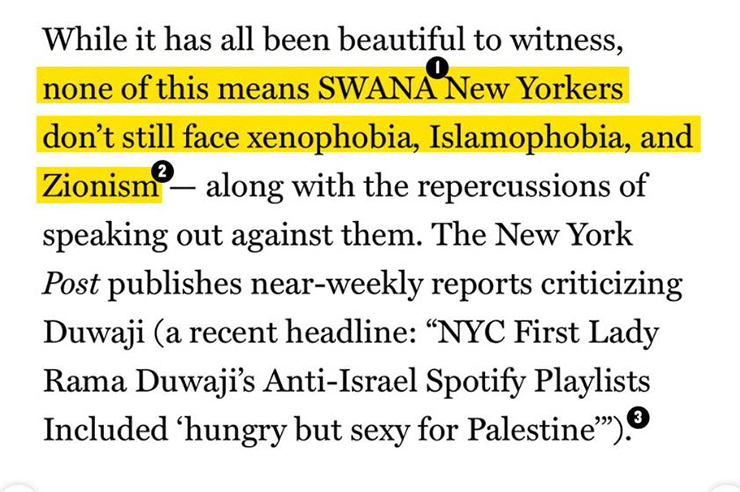
But then I considered the uptick in antisemitic incidents in which Israeli restaurants have been targeted by pro-Palestinian activists and this week’s edition of New York Magazine, whose cover is titled Habibi City. Partially as a response to the election of Mayor Zohran Mamdani and other candidates sharing his ethnicity, religion, and political views, the magazine coined a new acronym: SWANA, which stands for Southwest Asia and North Africa. In the Grub Street column, writer Madeline Leung Coleman highlights political tensions behind the region’s food.
“We were told this was the flavor profile of this young country, which was so richly funded and supported by our own,” she wrote in regard to the influx of Israeli restaurateurs in the city during the past decade. “The most popular dishes were Mizrahi, Arab, North African. Some were imported by Jewish immigrants. Many of the dishes were Palestinian.”
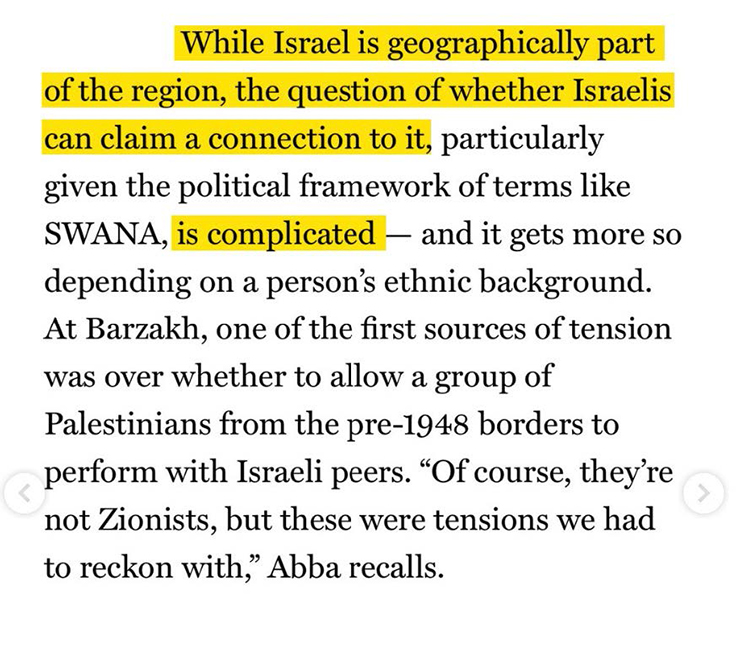
This assertion led the writer to the conclusion shared by Israel’s detractors that the country’s food, music, and art are not native, but are products of cultural appropriation, much like the theft of Palestinian land. She quoted Israeli chefs who credited their Moroccan, Persian, and Yemeni forebears for their culinary contributions. Ingredients such as fenugreek appear throughout the Talmud, and there are seven agricultural species singled out as specific to the land of Israel, but none of this appears in the magazine’s review of Middle Eastern food.
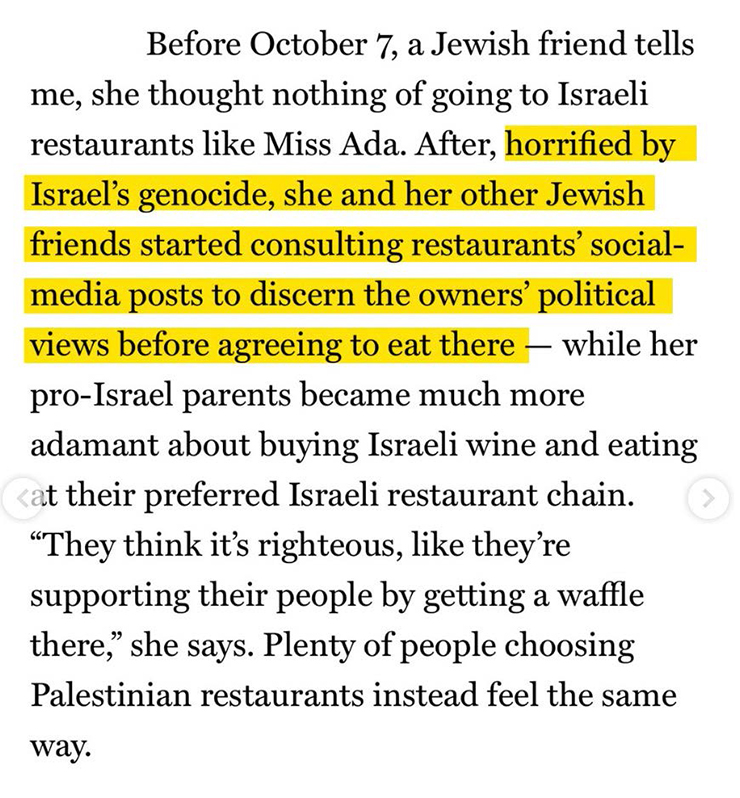
Coleman took note of how some Israeli restaurants choose the Mediterranean label either to hide their nationality or to recognize that the foods served represent a larger region. The troubling element in the story is an apparent invitation to readers to eat according to their political views. “Awareness of Israel’s genocide of Palestinians and the wars that keep proliferating have turned eating out into just one more way people are expressing their views on Gaza, on Lebanon, on Iran.”
The term for the intentional extermination of a people does not appear in quotes; it is not preceded by “so-called,” and there is no follow-up sentence explaining the concept. Genocide is treated as fact, bolstered by respected organizations, popular opinion, imagery, and treasonous Jewish individuals.
A column on culture excludes Israel from the SWANA label. “To be in the SWANA community meant embracing a set of shared beliefs: that Palestinians deserve human rights. That what happened in Gaza in the aftermath of October 7 constitutes a genocide.”
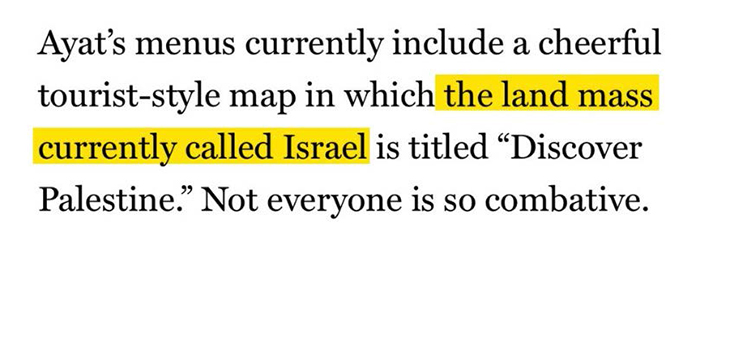
Returning to the food column’s review of a Brooklyn-based Palestinian restaurant, Coleman writes, “Ayat’s menus currently include a cheerful tourist-type map in which the land mass currently called Israel is titled ‘Discover Palestine.’” The writer regards Israel as a temporary entity.
Greeks and Turks both eat bourekas and regard the pastry as an example of their national cuisine. Italians regard pasta as central to their national cuisine, even though forms of pasta have origins outside Italy and similar foods developed across multiple cultures. The Moldovan menu is heavy on corn, and Ireland’s history is deeply connected to potatoes, vegetables unknown in Europe prior to Christopher Columbus. Only Israel is accused of cultural appropriation when it includes dishes and ingredients from the surrounding region.
Concerning the falafel, Jewish Press columnist Saul Jay Singer had a more nuanced and accurate approach in his column last month. “The debates over falafel’s cultural ownership have at once been comical and acrimonious, sometimes revealing deeper tensions in the Arab-Israeli conflict.”
He credited Egyptian Copts with the fried vegetable balls that spread across the region and attributed the dish’s popularity among Israelis to the fact that it conformed to Jewish dietary laws. The specific Israeli element noted by Singer is putting those balls inside a pita, popularized by Yemenite street vendors and Iraqi olim who supplied the condiments. That’s how any national dish is created, as a local adaptation of a foreign item, which truthfully is not foreign to Jews whose presence in Egypt predates the arrival of the Arabs.
In Queens, Bagels & Co. in Fresh Meadows exemplifies the magazine’s description of Israel. “This was a falafel- and bagel-literate society, urbane, health-conscious, every kitchen with a copy of Yotam Ottolenghi and Sami Tamimi’s Jerusalem cookbook… It was salad-forward, za’atar-laden, full of grilled meats, flatbreads, and fenugreek.” The restaurant openly displays its Israeli identity with flags on the rooftop facing a busy intersection.
The delegitimization of Israeli cooking, alongside the dehumanization of the country and allegations of genocide, has inspired acts of vandalism against this popular eatery. Unfortunately, because the damage was wreaked on flowerpots rather than people, Dawood Faisal would have been eligible to walk free for his hateful actions. He was kept in custody for an unrelated act that occurred a couple of days later at the corner of Union Turnpike and Francis Lewis Boulevard.
Faisal was speeding and doing stunts in his car, crashing it into two cars, one of which fatally hit Cara Trager, 71, who was crossing the street with her husband, Michael. He then tried to flee the scene as bystanders tackled him. “What’s crazy is we spoke about the hate crimes before she was killed,” their daughter Rachel Sales told amNewYork. “She had seen the video of the guy who ended up killing her.”
The toxic antisemitism on social media is difficult to control, as it depends on the comments and posts of countless individuals, but we should expect better from traditional media such as New York Magazine. The actions of a vandal toward an Israeli eatery hinted at a violent temperament that led to the death of Cara Trager. With her killer in prison, it is an ideal opportunity to examine which media he consumed that inspired him to hate Israel.