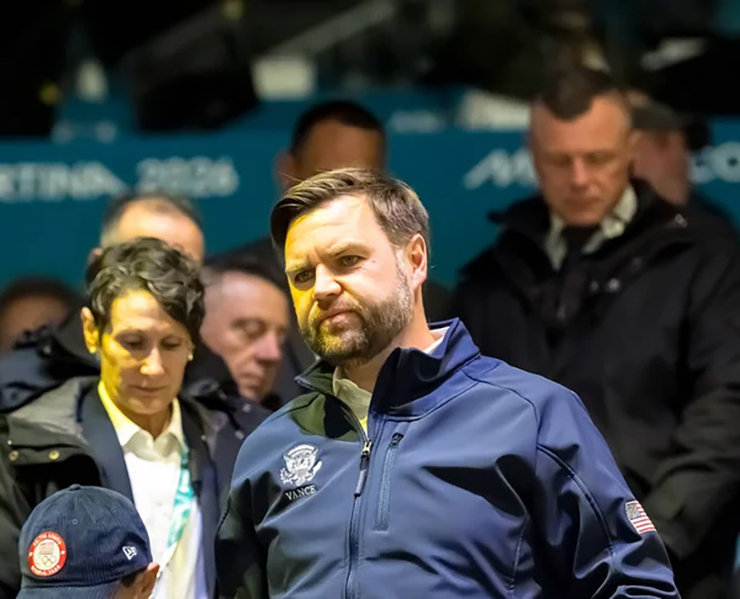
Vice President JD Vance’s performance in Switzerland over the weekend was more than bad optics. It was a warning. In high-stakes talks involving Iranian proxies and their cutouts, the man who currently leads early 2028 Republican presidential polling looked tentative, overly eager for any deal, and oddly deferential to players who have called for the destruction of the United States and Israel. In short, Vance is not following the “Peace Through Strength” policy of the Trump administration.
The contrast with President Trump and Secretary of State Marco Rubio could not have been starker. While Trump was issuing blunt warnings to Iran about the Strait of Hormuz and vowing consequences for proxy attacks on Israel, and while Rubio was actively working the phones to degrade Hezbollah in Lebanon, Vance was in a room in Switzerland being manhandled by our enemies. The Iranians stiffed Vance for a joint photo, ignored him in favor of the Pakistani delegation, and openly mocked President Trump immediately prior to the meeting.
This is not abstract criticism. It is the direct result of a worldview that underestimates America’s unique role in the world. Vance appears to treat America First ideology as isolationist, meant for domestic priorities alone, rather than the indispensable force that keeps sea lanes open, deters nuclear proliferation, and prevents regional powers from dominating their neighbors through terror proxies. When the vice president emerges from talks praising problematic actors like Pakistan—a nuclear-armed Islamist state with deep Chinese ties and a history of harboring America’s enemies—while downplaying the broader pattern of Iranian emboldenment, it suggests a dangerous comfort with managed decline rather than enforced deterrence.
Vance seems to be forgetting that the Iranians are the enemies and Israel is America’s ally in this war. While negotiating with an enemy is part of the job, it does not make sense to undermine allies. Holding Israel to a deal to which it is not a party, as it tackles an enemy that is not being negotiated with, only helps the Iranians, not America and her allies.
Compounding the concern is Vance’s proximity to Tucker Carlson. Carlson was labeled a skeptic of American foreign policy and is now actively trying to rewrite American history. What Howard Zinn did to the Left, Tucker Carlson is trying to do on the Right. The revisionist history includes labeling Winston Churchill the “chief villain” of World War II and portraying the conflict in ways that rehabilitate Nazi Germany’s choices while casting the Western Allies as the true aggressors or opportunists. This framing isn’t limited to history; it actively seeks to weaken America’s current role in the world, which in turn weakens America itself.
More recently, in the wake of Charlie Kirk’s assassination, Carlson claimed that Kirk was not killed because of his views on the trans agenda. In a recent interview, Carlson claimed, “Charlie Kirk was not murdered for his opinions on transgenderism. Obviously. Those of us who knew him best and called him a friend believe he was most likely murdered for his evolving views on Israel.” There is literally no evidence to back up this claim. Carlson makes it up out of whole cloth, and then hedges his bet by saying that he’s been wrong before.
Vance is not responsible for the insanity of Tucker Carlson, but he must be aware that his personal and political affiliations are part of his baggage. Vance’s weakness on foreign policy and the terrible optics coming out of this weekend will hang around his neck for years to come.
Polls currently position Vance as the clear frontrunner for the 2028 Republican nomination. That reality makes these patterns more, not less, urgent to examine. Early frontrunner status brings its own momentum, and momentum can harden instincts that should still be open to correction.
There is reason for measured optimism. Tucker Carlson has now effectively been ostracized from mainstream Republican circles, joining the ranks of Marjorie Taylor Greene and Thomas Massie as leaders of a fringe movement that is being rejected nationally. Carlson himself claims he is no longer a Republican. This fringe wing is largely online, and time will tell if its members will move from behind a keyboard to a polling booth. They haven’t yet.
There’s also Marco Rubio, another favorite. Rubio’s steady hand on Lebanon and Trump’s continued insistence on red lines provide models inside the administration itself. Vance’s political career could end with the vice presidency if he doesn’t get his act together on these key issues for the American people.
None of this is a call for #NeverVance. Foreign policy is one critical dimension of a presidency, and we’ve had plenty of presidents who have had terrible foreign policy. As bad as Vance is on this issue, the main criticism against him is that he acts and sounds like a Democrat. That is hardly an endorsement for whoever his Democratic opponent will be. It will be interesting if someone like Gavin Newsom ends up running to the right of Vance to try to win the Oval Office.
The task for conservatives who want both a strong America at home and a respected America abroad is straightforward: engage the frontrunner directly. Demand clarity on what “peace through strength” actually requires when the other side is an ideological regime that has spent decades chanting death to America and funding terror. Push for the kind of resolve Trump demonstrated over the weekend rather than the optics that dominated in Switzerland. Vance can still become the leader the moment demands. The question is whether the party will insist on it before the stakes become even higher.
Moshe Hill is a political analyst and columnist. His work can be found at www.aHillwithaView.com and on X at @HillWithView.