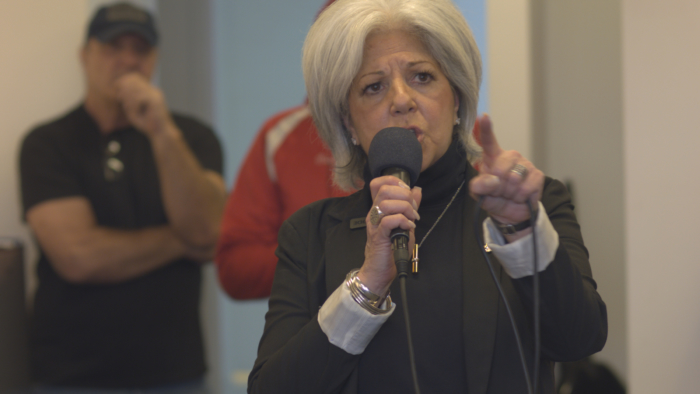
New York City Councilwoman Vickie Paladino is no stranger to having partisan attacks lobbied at her. Her public political persona began with a viral video of her as a citizen confronting then Mayor Bill DeBlasio on the street. She then turned a defunct corner of Queens into the Republican hotspot in New York City, winning a council seat (and the admiration of New York Republicans statewide) for her efforts. The Democrats view her as public enemy #1, so they are using their governmental power to file ethics complaints in an attempt to bring her down.
The facts are straightforward, yet revealing. Paladino posted on her personal X (formerly Twitter) account about real-world events: terror attacks abroad and what she sees as the steady Islamization of Western institutions. Critics labeled the posts “Islamophobic.” The Council’s ethics panel seized on them to launch disciplinary proceedings that could lead to censure, suspension, or even expulsion. Paladino complied with Speaker Julie Menin’s request to delete one post, showing good faith. Yet the machine rolled on. Her attorney, Jim Walden, rightly demanded a permanent injunction, arguing that personal political speech outside official duties cannot be reclassified as “workplace misconduct.”
This isn’t just a procedural spat. It is a defining test of whether free speech still exists in New York City under one-party Democratic rule. The city that allows streets to be shut down and college campuses to be taken over by students aligned with terror organizations is suddenly very concerned with one particular social media account. Paladino’s case exposes how the Democratic majority weaponizes “ethics” and “harassment” rules to punish the lone Republican voice willing to challenge the prevailing orthodoxy on immigration, Islam, and culture.
The New York City Council’s Democratic supermajority, operating through its ethics committee, has charged her with “disorderly conduct” and workplace harassment for remarks deemed inflammatory. Paladino sued to stop the proceedings, arguing a blatant violation of her constitutional rights. Judge Sabrina Kraus didn’t issue an immediate ruling, but her pointed questions laid bare the absurdity: How exactly does a tweet from a private account “disrupt Council proceedings”? And why does this feel like “the majority is attacking the minority”?
Judge Kraus cut to the constitutional core. “I do not see how a tweet on a personal account disrupts Council proceedings,” she observed, echoing decades of Supreme Court precedent. From New York Times v. Sullivan (1964) to Snyder v. Phelps (2011), the First Amendment protects even “hateful” or “problematic” speech—terms the judge herself used—when it occurs in the public square or on private platforms. Social media is today’s public square. Elected officials do not shed their citizenship when they log on after hours. Paladino wasn’t shouting during a Council meeting or drafting legislation; she was expressing constituent concerns as a private citizen who happens to hold office.
The selective enforcement is what makes this case reek of partisan retaliation. Paladino has never filed ethics complaints against Democratic colleagues whose statements—on Israel, policing, capitalism, or conservatives—have been far more vitriolic. Yet the Democratic majority, which holds 45 of 51 seats, faces zero accountability for its own rhetoric. Judge Kraus herself noted the apparent double standard. When the powerful target the powerless under the guise of “civility,” democracy suffers. This is not ethics enforcement; it is political cleansing.
This matters beyond one councilmember. As we approach the 250th anniversary of the founding of our nation, the freedoms that we enjoy in America are being eroded. In 2023, over 12,000 people in the United Kingdom were arrested and charged over something they wrote on social media. Pretending that American free speech is commonplace, or that there aren’t many people who would be happy to see it become a relic of the past, is naive at best.
New York City operates under one-party control. Democrats dominate every lever: the Council, the mayor’s office, the courts, the unions, the media echo chamber. New York State is the same. The difference at this point between the socialist radicalism of NYC and the representation in Albany is minimal. The minority of Republican members of Assembly and Senate could be censured or even expelled if they say common sense statements like men are not women, radical Islamic terror is a danger to our society, or we must control American borders. Yesterday’s “offensive” tweet becomes tomorrow’s grounds for expulsion.
Paladino’s defense highlights the hypocrisy. Her lawyer presented examples of Democratic councilmembers’ inflammatory remarks—racist jabs at conservatives, calls to defund police during crime spikes, or rhetoric that could easily be spun as anti-Jewish or anti-white—that drew no ethics complaints. The Council’s motion to dismiss her lawsuit as “meritless” only underscores their confidence in their power. Yet Judge Kraus’s skepticism suggests the judiciary may yet check this overreach. Her encouragement of an out-of-court resolution signals she sees the case’s political stench and wants to avoid a precedent that guts the First Amendment.
Critics will counter that Paladino’s posts were “hateful” and therefore unworthy of protection. This misses the point entirely. The First Amendment exists precisely for speech that offends. Popular speech needs no safeguard. As Justice Oliver Wendell Holmes famously wrote, it is the “freedom for the thought that we hate” that tests our commitment. Paladino’s views, whether one agrees or not, engage live public controversies: terrorism, cultural cohesion, governance by officials with ties to foreign ideologies. Dismissing them as “harassment” because they occur in a workplace-adjacent context is legal sophistry. Councilmembers are public figures. Their private expression informs their public service; voters judge it at the ballot box, not ethics panels.
The stakes extend to every New Yorker. If the Council succeeds, any elected official who criticizes the dominant narrative—on crime, housing, education, or borders—risks investigation. Social media, once a democratizing force, becomes a surveillance tool for the majority party. New York City, already hemorrhaging residents and businesses amid high taxes and soft-on-crime policies, cannot afford an intellectual monoculture too.
Paladino herself has struck a pragmatic tone. “Anybody who knows Vickie Paladino knows that I am always looking to work something out,” she said outside court. That willingness to compromise stands in stark contrast to the Council’s rigidity.
As this case proceeds—whether to settlement or full injunction—the message must be clear. New Yorkers of all political stripes should defend Paladino’s right to speak, even if they reject her conclusions. Free speech is not a Republican issue or a Democratic issue; it is an American issue. When Democrats in City Hall treat a colleague’s private posts as a firing offense while ignoring their own excesses, they reveal the authoritarian streak lurking beneath progressive rhetoric.