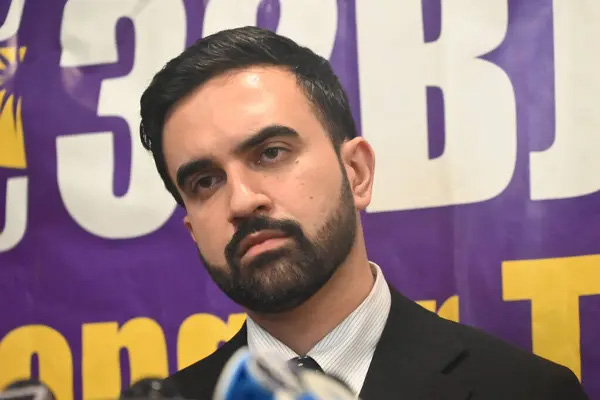
Zohran Mamdani assumed office as mayor of New York City amid high expectations from his democratic socialist base and rock-bottom expectations from everyone else. Behind his smarmy smile and his social-media presence is an empty suit whose socialist goals are getting a bucket of cold water dumped on them, alongside a series of appointments and decisions that have left residents either scratching their heads or running for their lives.
One hundred days into Zohran Mamdani’s tenure as mayor of New York City, the democratic socialist experiment is unraveling under scrutiny from both the political center-right and even his own far-left base. Right-wing commentators and moderate Democrats have seized on Mamdani’s record as proof that ideological extremism, cloaked in a smarmy smile and a robust social media account, is actively harming the city’s economy, public safety, and its Jewish community. At the same time, the socialist left—once his most fervent supporters—is voicing growing frustration as fiscal and political realities force the mayor to abandon or dilute the very promises that propelled him into office. The result is a mayor caught between two fires: accused by centrists of fanning division and fiscal recklessness, and by radicals of selling out at the first hint of governance.
From the perspective of right-wing analysts and moderate Democrats, Mamdani’s leftist extremism represents a danger and a reversion to the New York City of the 1970s and 1980s. Critics argue that his administration has prioritized ideological purity over the practical needs of a city still grappling with post-pandemic recovery, crime concerns, and terrorism threats. Foremost among these complaints is the mayor’s handling of antisemitism, which remains the dominant category of hate crimes in New York, accounting for more than half of all incidents in a city with roughly one million Jewish residents—the largest population outside Israel. The numbers in January were so atrocious that Mamdani literally changed the method of categorizing antisemitic hate crimes to artificially lower the statistic—and there was still an increase over last year.
Mamdani’s appointment of Phylisa Wisdom to combat the issue drew immediate backlash from the Jewish community, which saw little evidence of meaningful progress. His public stances have only deepened the unease: repeated calls to arrest Israeli Prime Minister Benjamin Netanyahu on any visit to New York, opposition to Israel framed as rejection of a “hierarchy of citizenship based on religion,” and a conspicuous silence on human rights abuses in places like Iran and Afghanistan. Mamdani’s refusal to distance himself from the views of his wife, Rama Duwaji—who has been accused of endorsing elements of the October 7, 2023, attacks—further normalizes the Jew-hatred in his orbit.
Economic and governance failures have further fueled outrage from the center and right. Mamdani campaigned on “tax the rich,” yet his proposed 9% across-the-board property tax hike was widely viewed as a direct assault on middle-class New Yorkers. When the City Council rejected the increase as reckless, the mayor pivoted to Albany and Washington seeking higher corporate and high-earner taxes—moves critics say will ultimately stifle growth and drive businesses away. His “Rental Ripoff” hearings excluded tenants of the New York City Housing Authority (NYCHA), the very public housing residents under his direct responsibility, while a judge held the Department of Housing Preservation and Development in contempt, earning the administration the label of the city’s worst landlord. Even his signature social programs have drawn fire for inefficiency and excess: the creation of what detractors call the nation’s most expensive public daycare system, priced at roughly $60,000 per child for a limited number of slots, while library funding was slashed by $30 million, falling to just 0.39% of the budget despite explicit campaign pledges to protect it.
His failures border on a comical Reagan-era story about the Soviets, except no one is laughing. The promised Department of Community Safety, once envisioned as a $1.1 billion overhaul dispatching social workers to non-violent 911 calls, has been reduced to a skeletal Mayor’s Office with two staffers and a $260 million budget. Plans to disband the NYPD’s Strategic Response Group were abandoned after the mayor described the matter as an “active conversation,” while he quietly retreated from eliminating the gang database. Initial opposition to homeless encampment sweeps gave way after winter storms left at least 29 people dead outdoors, forcing a pragmatic reversal that underscored the limits of his “defund-adjacent” approach. Free buses, city-owned grocery stores (now downgraded to a $70 million scouting mission with none open), and aggressive tenant protections have similarly stalled or been walked back.
These retreats are not signs of moderation but proof that Mamdani’s leftist extremism was never viable—merely performative theater that has left New Yorkers facing higher costs, persistent street crime risks despite some statistical declines, and a mayor whose 48% approval rating already trails his predecessor’s at the same stage.
Mamdani’s own socialist base has begun to voice sharp complaints of their own. The far left, which propelled his victory through democratic socialist networks, now sees the mayor as capitulating to political and fiscal realities that expose the fragility of his campaign vision. The scaling back of flagship initiatives—like the five city-run grocery stores reduced to exploratory funding, the Community Safety Department stripped of its revolutionary scope, and the failure to fully disband elite police units or eliminate the gang database—is comical to the right but devastating to the left. These socialists aren’t learning that their proposals aren’t feasible; they’re claiming that Mamdani isn’t radical enough to accomplish them (which, to a conservative Republican, is even more hilarious).
Countless promises have been either completely broken or scaled back to the point of inconsequence. Promises to drop city lawsuits against the CityFHEPS voucher expansion were betrayed by an appeal that kept litigation alive, while support for stricter school class-size limits has softened amid budget pressures. Library funding cuts and the mayor’s misrepresentation of a $5 billion budget deficit—coupled with claims that the City Council pushed for deep service reductions—have sparked accusations of lying with the numbers.
If that’s not enough, socialists are particularly livid that Mamdani couldn’t bend reality to his whim on housing and policing. The potential rent freeze through Rent Guidelines Board appointees is viewed as insufficiently aggressive, while backtracks on free buses and homeless sweeps—driven by winter deaths and public backlash—have been labeled betrayals of the “warmth of collectivism.”
One hundred days in, Zohran Mamdani finds himself with a 48% approval rating (for context, Eric Adams had a 61% approval at this point in his term). He hasn’t earned any friends on the right or moderate left, and he’s bleeding support from his socialist base. Yet he is the “great hope” of the Democratic Party, with countless Democrats from around the nation picking up his messaging and policies and passing them off as their own. Reality doesn’t matter; only winning does. Mamdani can win an election, but after 100 days in office, we’re still not sure if he can do anything of value with that win.
Moshe Hill is a political analyst and columnist. His work can be found at www.aHillwithaView.com and on X at @HillWithView.