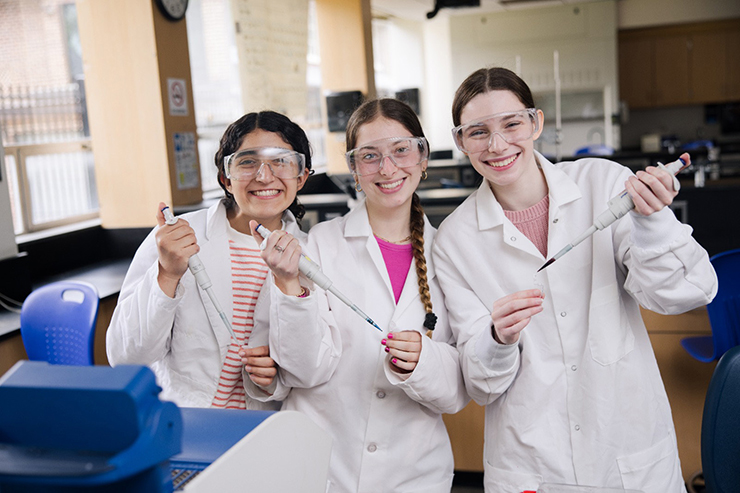
At Yeshiva University High School for Girls, the Science Institute has spent the past three decades proving a powerful idea: When young women are trusted early with real scientific research, the confidence they gain lasts a lifetime.
The program invites high school students into professional laboratories, holds them to real standards, and lets them discover their capabilities. Students commit to a rigorous three-year course, including two summers of authentic research at institutions such as the Albert Einstein College of Medicine, Stony Brook University, NYU, Hofstra University, Rockefeller University, Cooper Union, and Shaare Zedek Medical Center. Many present their work at national and international competitions and symposia – experiences typically reserved for graduate students.
Institute Director and YUHSG Science Department Chair Mrs. Ruth Fried, who has mentored students since the program’s start, said: “Confidence doesn’t come from being told you’re capable. It grows when students are trusted with real work. When that trust is given early, they rise to it in ways that stay with them long after they leave the lab.”
This fall, alumnae spanning nearly 30 years reflected on how these early experiences shaped their lives. Their responses showed a consistent theme: serious research builds lasting confidence – not only in science, but in life and work.
One alumna (Class of 2015) recalled feeling deep responsibility in a lab as a tenth grader, learning to approach every task with integrity – a habit that still guides her challenges. Another (Class of 2012) realized in hindsight how rare it was to conduct legitimate research in high school.
This sense of belonging is especially meaningful for young women in STEM, where confidence – not ability – is often the first barrier. Alumnae pursued careers in medicine, engineering, psychiatry, health technology, science education, and beyond. Even those who pivoted emphasized that research developed critical thinking, persistence, problem-solving, and intellectual courage that remain central to their work. Many continued to advanced study at leading institutions including MIT, Columbia, Johns Hopkins, and AECOM.
A licensed clinical psychologist (Class of 2013) specializing in PTSD treatment credits the program for her confidence as a clinician: “This was my first real foray into formal research. Through summer work at Einstein and Stony Brook, I learned to ask good questions, think critically about data, and present with confidence.” She entered a scientist-practitioner PhD program and still draws on research in therapy and conferences. “That mindset began in high school. My identity as both clinician and scientist started back then.”
A physician in internal medicine (Class of 2011) said early high-level expectations reshaped her sense of capability: “The pressure put on us was actually a belief in us – that we could surprise ourselves and achieve beyond what we thought possible.”
Alumnae spoke of seeing science as deeply connected to values, ethics, and identity. One (Class of 2018) was struck by the compassion required in clinical work while shadowing an OB-GYN: “Every day brought new stories that opened my eyes to patient care realities. It’s a big part of why I’m pursuing medicine today.
These reflections affirm what educators and families have long hoped: Authentic high school research prepares students not only for college, but for the workforce and for life.