You can take us out of Queens, but you can never take Queens out of us.
There was something about growing up in Queens that’s difficult to explain to someone who didn’t grow up there.
It wasn’t just the streets we walked, the pizza stores we frequented, or the places we spent our Saturday nights.
It was a feeling. A connection. An understanding.
And if you grew up in Queens, I have a feeling you know exactly what I’m talking about.
I grew up in Forest Hills, on 69th Road, between 112th Street and the service road of the Grand Central Parkway. Our house was in a rather unique location.
Long before cell phones, people would knock on our door at all hours asking for directions or to use the telephone after an accident near our corner. Our home became something of an unofficial emergency telephone stop!
We also lived along the bus route from Kew Gardens Hills toward 71st and Continental Avenue. Every time a packed bus passed, our house would shake.
Those were the sounds and experiences of my childhood. And I wouldn’t trade them for anything.
But what made growing up in Queens so special wasn’t our house or even the places we frequented.
It was the people.
My family didn’t have much money. Yet I never really knew who had money and who didn’t.
Our parents were doctors, educators, lawyers, businessmen, and people in all kinds of professions. Families undoubtedly had different financial circumstances, but somehow, we seemed to live relatively similar lives.
Money wasn’t what defined you.
What mattered was being a good person. Being sincere. Being genuine.
You were valued for who you were, not what you had.
At least, that’s how I remember the Queens of my childhood.
Our world stretched from Forest Hills and Kew Gardens to Kew Gardens Hills and Hillcrest.
We attended different schools: Yeshiva of Central Queens, Yeshiva Dov Revel, Tiferes Moshe, Bais Yaakov, Shevach, Ohr Torah, Chofetz Chaim, and Yeshiva High School of Queens, which later became part of Yeshiva University High School for Girls, my alma mater.
Each school had its own identity and friendships, but somehow, we were all connected.
Our friendships weren’t limited to children in our grade or school. Many of my school friends lived in other neighborhoods, while my shul friends were often children of different ages whose parents were friends with mine.
We didn’t think much about age differences. We simply grew up together.
And then, of course, there were the places!
Remember Zion’s Pizza on 108th Street?
As we got older, there were Shimon’s and Benji’s. But let’s be clear: If we’re talking about the best pizza, nothing compared to Naomi’s, all the way down Main Street.
And then there was Cho-Sen Garden.
For so many of us, it was much more than a restaurant. It was where we celebrated birthdays, special occasions, and milestones. Mr. Bob, and later Mr. Michael, were familiar faces who made every visit feel personal.
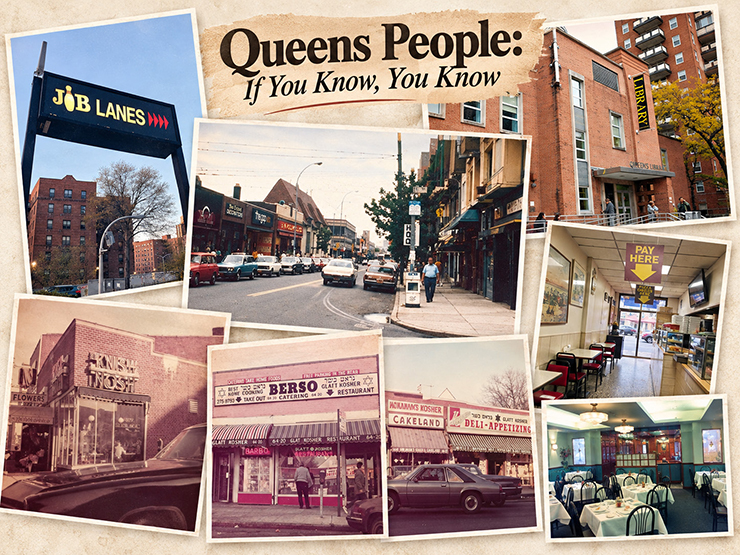
There was K-Roasters on Queens Boulevard, Traditions on Main Street, and who could forget Berso (New Forest), the family-owned takeout restaurant on 108th Street with the most incredible coleslaw?
And Austin Street!
How many hours did we spend walking up and down Austin Street? Shopping, meeting friends, looking in store windows, talking, laughing, and sometimes doing absolutely nothing at all.
We had Hollywood and JIB Lanes for bowling and movie theaters on Main Street and Continental Avenue. We had Flushing Meadows Park for Tashlich, the Tennis Stadium, and Shea Stadium, all landmarks that were part of the fabric of our neighborhood.
And we had the Forest Hills Public Library.
Going to the library was an outing! My mother would take my sister and me, and we could spend hours choosing books. I wasn’t even much of a reader, but I remember those visits so clearly.
It wasn’t always about what we were doing. It was about being together.
On Shabbos, we walked.
We walked to friends’ homes and across neighborhoods. Sometimes my school friends came to Forest Hills, and sometimes I walked to them. Distance didn’t seem to matter where friendship was involved.
And who could forget the Turtle Park?
On Shabbos afternoons, people gathered from all over Forest Hills. You didn’t need an invitation, a plan, or a telephone call.
You just knew.
Saturday nights were much the same. We knew which pizza store everyone would be at, where to go, and whom we’d see.
No cell phones. No group chats. No endless messages asking where everyone was.
Somehow, we always found one another.
I remember visiting friends from camp who lived outside Queens. I loved those visits, but there was always something special about the trip home.
As I made my way back to Forest Hills, I felt a sense of calm, of returning to where I belonged.
It wasn’t that there was anything wrong with where I’d been.
It was simply that Queens was home.
And home had a feeling all its own.
Today, so many of us have moved away. We’ve raised families, built careers, and created communities of our own.
Yet something remarkable happens when I meet someone who grew up in Queens.
There’s an immediate connection.
All it takes is mentioning a street, a school, a restaurant, or a familiar family name. Suddenly, the stories begin, the memories come flooding back, and decades seem to disappear.
But I believe that connection goes deeper than shared memories.
It’s a recognition of something in one another. A certain groundedness. An appreciation for people, for friendships, and for the simple things that made our childhoods so rich.
I am enormously grateful for the childhood I had, the friendships I made, and, most of all, the values our parents instilled in us.
We didn’t know it then, but we were growing up with something very special.
You can take us out of Queens, but you can never take Queens out of us.
Queens people. If you know, you know.
By Debbie Meskin Rochlin