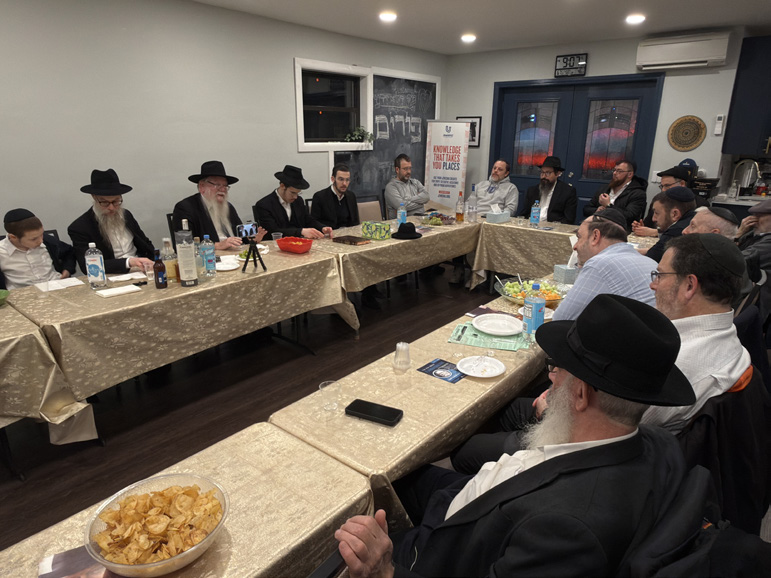
Just days before Pesach, guests gathered at Chabad on Campus of Queens, inside the Rohr Chabad House and Caplan Student Center at Main Street and 69th Avenue in Kew Gardens Hills, for a Yud-Alef Nissan farbrengen hosted by Rabbi Shaul and Tzipah Wertheimer.
Yud-Alef Nissan marks the birthday of the Lubavitcher Rebbe, Rabbi Menachem Mendel Schneerson, ob”m, whose final resting place is at the Ohel in Montefiore Cemetery in Cambria Heights. The day is observed annually with farbrengens, reflection, and a renewed commitment to Torah and shlichus. With hundreds of thousands visiting the Ohel annually—particularly around this date—the impact of the day resonates globally. Falling so close to Pesach, the day leads naturally into a time of reflection and preparation. The event followed the traditional farbrengen format: a table, a few refreshments, and an unfolding, organic conversation.
Rabbi Yehudah Weg, who was sent by the Rebbe on shlichus to Tulsa, Oklahoma, in 1987 along with his wife, Etel, led the evening’s discussion. Rabbi Wertheimer shared a personal connection to the guest speaker, noting that in his own home, coffee is roasted for Pesach starting from green beans—a tradition adopted from Rabbi Weg.
The conversation shifted to Rabbi Weg’s years as a bochur, specifically the experience of receiving handmade matzah directly from the Rebbe. He recalled how the matzos were handed over with both hands, with the Rebbe ensuring they were whole. One vivid memory included a distribution of matzah specifically for those who had been in Washington that day; for those present, the moment remains etched in their memory.
Before departing for Tulsa, Rabbi Weg carried a central directive: his role was not merely to manage programs or hit certain numbers, but to serve as a “living example of what it means to be happy to be a Jew.” He emphasized that when people witness genuine simcha, curiosity follows. When it becomes clear that the source of that joy is Torah and mitzvos, it draws people toward the lifestyle.
Establishing a presence in Tulsa required a nuanced approach. To avoid local tension in a community with few Jewish children, Rabbi Weg opted to open a “Tuesday school” rather than a traditional Sunday school, running the program quietly for a decade.
One of the evening’s most poignant accounts involved a Holocaust survivor named Andy, who initially approached Rabbi Weg by stating, “I hate Jews.” Rather than arguing, Rabbi Weg made a distinction: what Andy had endured was at the hands of individuals, but it was not Judaism. Eventually, Andy agreed to visit 770 Eastern Parkway in Crown Heights. Seeing a vibrant community learning and living, Andy observed a distinct happiness that lacked the “sadness” he associated with his history.
The following day, Andy stood in line to receive a dollar and a blessing from the Rebbe. He asked for “satisfaction” with his Judaism, to which the Rebbe responded that one should never be satisfied, but always continue to grow. This encounter sparked a transformative journey for Andy, leading to his first use of tefillin, a traditional Jewish wedding, and a legacy continued by his son.
As Pesach approached, Rabbi Weg shared a story of a family whose daughter was in treatment for an eating disorder. Though she was scheduled for release just before the holiday—a high-risk time for relapse—insurance initially refused to extend her stay. After the father sought a blessing through the Rebbe, the decision was unexpectedly reversed the following morning, granting two additional weeks of critical care.
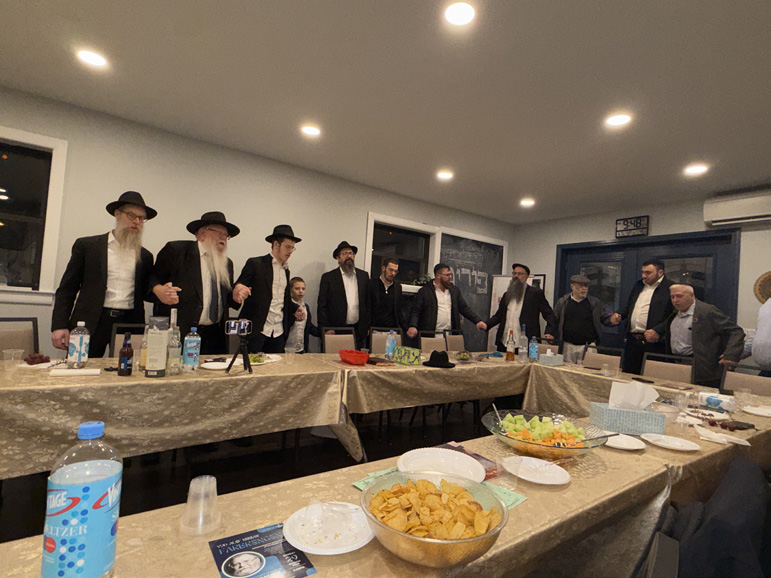
A central theme ran through the evening: the role of a Jew—and a shliach—is defined not by titles, but by how one lives. When there is visible simcha in Torah and mitzvos, it speaks for itself. The farbrengen concluded in traditional fashion, with conversations lingering long after the formal discussion ended.
A Shabbos Afternoon Vision
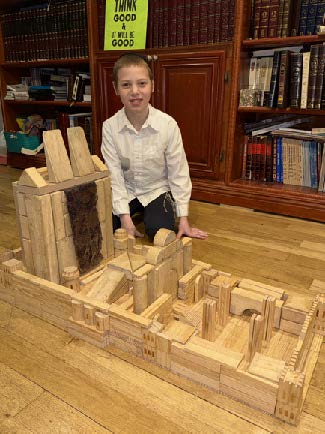
During the farbrengen, the Wertheimers’ son, Zalmy, presented a detailed rendering of the Beis HaMikdash he had constructed using blocks from around the house. He explained that every piece was placed with intention, striving for accuracy according to his studies.
The project served as a tangible example of a Chabad home, where even a Shabbos afternoon becomes an opportunity to connect with the Rebbe’s teaching of living with the Beis HaMikdash as a present reality rather than a distant memory. Watching Zalmy proudly share his creation, that concept felt immediate and real.