Five-year-old Meirav Shaked was walking down the street with her cousins during a visit to their grandmother’s home when she heard beautiful singing drifting from a nearby building. The melody touched her soul, carrying a deep sense of holiness. It was only years later that Meirav realized that what she had heard that day was actually the sound of t’filah.
Twenty-three years ago, Meirav and her husband established a business that they jointly ran for 15 years. Meirav was entirely consumed by the stress of running a business, all while raising four children. Seven years ago, when she realized the pressure was no longer sustainable, she stepped away from the business to rest and recharge.
During this break, Meirav embarked on a life-altering spiritual journey. She began studying the Tanya, and a year later, took on the daily practice of learning Chumash and saying T’hilim. Though Meirav does not define herself as fully observant, she discovered a deep, unshakeable emunah (faith). This daily learning gifted her with three important realizations: that Hashem loves her unconditionally, that He is always available to her, and that His hashgachah pratis (Divine providence) watches over her every step. Her life soon became filled with small, everyday miracles, and her relationship with Hashem grew stronger.
As an artist and writer, Meirav naturally channeled this newfound spiritual energy into her work, publishing an artistic book of songs. Wanting to leave her readers with a brachah, she requested that her designers feature two p’sukim from T’hilim on the very last page: “Ki mal’achav y’tzaveh lach, lishmarcha b’chol d’rachecha. Hashem yishmor tzeischa u’vo’acha, mei’atah v’ad olam” – “He will command His angels about you to guard you in all your ways... May Hashem guard your going out and your return, from now and for all time.”
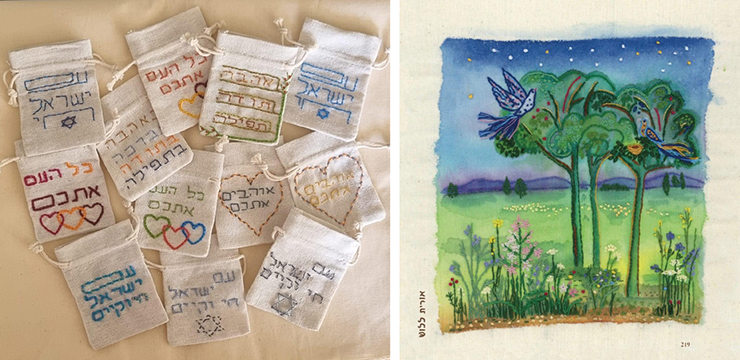
When Meirav received the digital proofs of the book, she opened the final page and gasped. Seeing those p’sukim surrounded by beautiful, simple embroidery moved her to tears. In that exact moment, she knew what she wanted to do next. She decided she would publish an entire book of T’hilim illustrated with embroidery. She would call it Rokmotehillim – a play on the Hebrew words for embroidery (rokmah) and T’hilim.
But life got busy, and the project sat on a shelf. Six months later, Meirav was finally ready to put out an open call for women to join her.
The night before she was set to post the announcement on social media, Meirav fell ill with a high fever. In her delirium, she hallucinated images of women sitting in a circle, embroidering together. When the fever broke, she woke up with a stark realization: She had almost missed the entire point. She had originally planned to run the project remotely, but she realized that the true mission was to bring people together. She immediately changed course and decided to open her home.
When Meirav finally posted the call to action on Facebook, the response was overwhelming. By the end of the project, a broad spectrum of 154 women had stepped forward, creating a magnificent human mosaic. They ranged in age from 17 to 97. There were women from the political left and the right, religious and irreligious, Israelis from all over the country, two participants from the United States, and even a set of blind twins. Each woman chose a perek or a pasuk from T’hilim that resonated with her soul and created an artistic, embroidered expression of it.
Time and time again, these vastly different women gathered around her table to stitch, laugh, cry, and build a sense of community. Some were hesitant, unfamiliar with the craft of embroidery. But Meirav told them, “If blind women can do it, so can you.” And they did. Even after finishing their individual squares, many kept coming back just for the camaraderie, unwilling to leave the warmth of their new friends.
Then came the outbreak of the war on October 7. Across the country, saying T’hilim instantly became a national lifeline. Everyone, religious or not, was desperate to daven for the soldiers, the wounded, and the hostages. More women eagerly joined the project, looking for comfort and connection.
Meirav had initially planned to gift a small Sefer T’hilim to each of the 154 contributors, in appreciation of their work. However, during the war, another inspiration struck. Instead of ordering 154 books, she ordered 1,500. She asked the women to embroider messages of chizuk (strength) onto small sachets, tucked a Sefer T’hilim inside each one, and sent them directly to combat soldiers on the front lines. Even the most secular soldiers were overcome with emotion upon receiving them, holding a tangible piece of the nation’s love in their hands.
Today, Meirav is bringing her message to a wider audience, sharing Rokmotehillim (“Threads of Psalms” in English) through online sales and traveling to display the original embroidered artwork in communities across Israel and abroad. Decades after a little girl on a street corner followed the sound of singing, she has brought those same melodies back to life – proving that the ancient Psalms of T’hilim, among the oldest songs of our people, still have the unique power to stitch our people together.
Suzie Steinberg, (nee Schapiro), CSW, is a native of Kew Gardens Hills and resident of Ramat Beit Shemesh who publishes articles regularly in various newspapers and magazines about life in general, and about life in Israel in particular. Her recently published children’s book titled Hashem is Always With Me can be purchased in local Judaica stores as well as online. Suzie can be reached at This email address is being protected from spambots. You need JavaScript enabled to view it. and would love to hear from you.