The one-minute siren wailed loud and clear at the start of Yom HaZikaron. However, this year’s siren came with a sobering clarification: In the case of a real event – if, chas v’shalom, a missile were launched toward us – the sound would be modified to oscillate up and down. In the end, the mournful siren pierced the night in a steady, haunting fashion, as it always does.
The city of Beit Shemesh commemorates 139 fallen residents who lost their lives in Israel’s wars and terror attacks. This year, tragically, 12 names were added to the list, including the nine killed in Iran’s missile strike less than two months ago. Hundreds of people attended ceremonies across the city to honor them.
This morning, a group of about 30 English speakers gathered for a tekes (ceremony) in a local garden in Ramat Beit Shemesh shortly before the morning siren. Amanda Bradley tearfully spoke about several of her son Yehuda’s friends who were killed in Rafah in June. She described the moment their armored vehicle was struck by an anti-tank missile, killing all eight soldiers inside. Among them was Company Commander Captain Wasim Mahmoud, from the Druze community, who had handpicked his soldiers for their unique strengths.
She spoke about Yakir Levy and Shalom Menachem, best friends, who had studied together in high school and in Yeshivat Hesder Shaalvim, and then enlisted together in combat engineering. Yakir always said that he and Shalom would be “together until the end.” Tragically, they were killed in the same incident and are buried side by side at Har Herzl Military Cemetery. Indeed, together until the end.
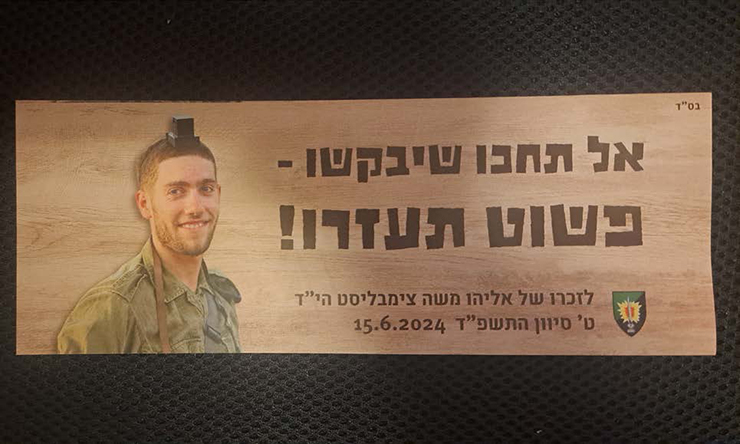
Amanda also spoke about Eli Moshe Zimbalist, a resident of Beit Shemesh who had been friends with her son for years. She always felt that Eli Moshe would look after Yehuda and that because of that, he would be okay. She told a story of a day she had a flat tire while driving the boys to their base. Even though the boys were late – a punishable offense in the army – Eli Moshe insisted on changing the tire himself. He was simply incapable of not helping.
The things that Amanda said about Eli Moshe fit perfectly with what I had heard earlier in the week from his mother, Sara Zimbalist. She described “Eli Mo” as someone who lit up the world in a quiet, humble way. Though he faced challenges in learning, he grew from every experience. He worked on himself and did cheshbon ha’nefesh. As a young teenager, he would leave notes under his pillow detailing exactly what he wanted to accomplish the next day.
He was also filled with hakaras ha’tov. She recently found a thank-you note he had written to his parents when he was just 11 years old, thanking them for taking him to a reading specialist in Yerushalayim. That’s when he learned how to read. The Zimbalists invested their time and money for this despite the difficulty, because they wanted him to be able to lein at his bar mitzvah. Finding that note during the week of his bar mitzvah parshah felt like a hug from Hashem.
Sara described Eli Mo as an observer and a doer. He would see a need or a problem and find a solution. When he noticed his friends had trouble getting up for davening, he became their alarm clock. The driver who took Eli Mo’s unit to the Gaza border even came to the shiv’ah to share that Eli Mo was the only soldier who stopped to ask how he was doing.
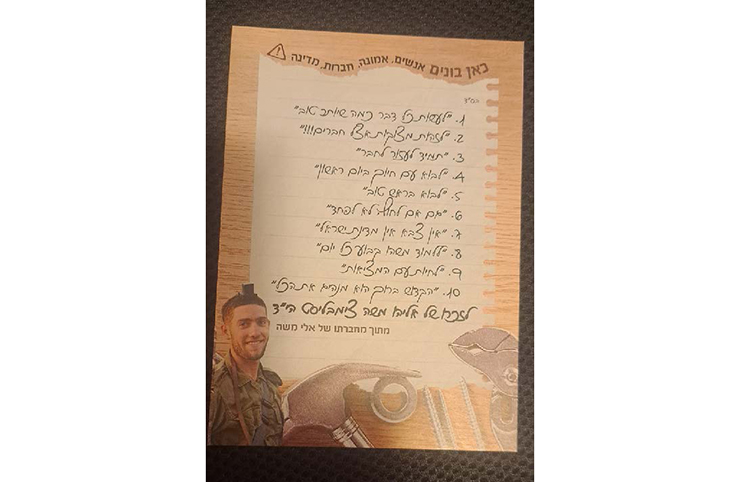
On the night before the shloshim for Eli Mo, the Zimbalists found a notebook containing sentences Eli Mo had written to help himself grow. They now distribute a list of 18 sentences so that others can continue that growth in his memory.
Before the ceremony ended, Gil Karsenty, the organizer, approached the podium with his son Achiad, who stood in his IDF uniform. Gil recited an emotional Kaddish, making special mention of Achiad’s friend, Barak Kalfon, who was killed in combat in Lebanon just this past Friday. Achiad fought in that same incident. Even at age 48, Barak showed up for the reserves time after time with a smile out of a deep sense of mission, leaving behind a wife and two children, parents, and siblings. Gil ended with a poignant reminder: Yom HaZikaron is only one day. For the other 364 days of the year, he urged us, we must make the choice to live happily.
We hope that no more names will be added to the long list of fallen soldiers and victims of terror. Please continue to daven for peace in Eretz Yisrael and for the success and safe return of all our chayalim.
Suzie Steinberg, (nee Schapiro), CSW, is a native of Kew Gardens Hills and resident of Ramat Beit Shemesh who publishes articles regularly in various newspapers and magazines about life in general, and about life in Israel in particular. Her recently published children’s book titled Hashem is Always With Me can be purchased in local Judaica stores as well as online. Suzie can be reached at This email address is being protected from spambots. You need JavaScript enabled to view it. and would love to hear from you.