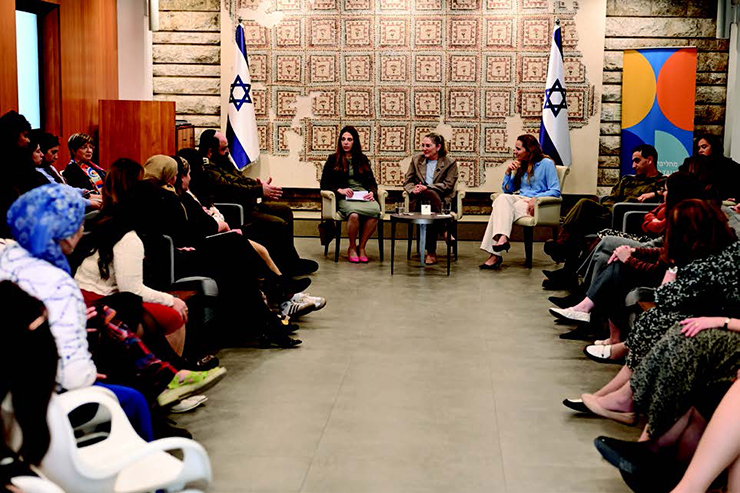
Osot Chayil, an organization that supports chareidi women whose family members have joined the army, continues to encourage those who turn to it. This week, they invited me to join them for a Day of Appreciation with Michal Herzog, wife of President Isaac Herzog.
Already at the entrance to the President’s Residence, the women buzzed with anticipation about the meeting ahead. While some of the women were closely connected through their involvement with Osot Chayil, there were also new faces. These women have husbands and sons serving in combat units, technological units, and on the home front in the regular and reserve forces.
After passing through security, we were led to a reception room lined with Israeli flags and state symbols. There, we waited for the First Lady to arrive. She and the President had returned from Australia only two days earlier. First, Chavy Erenfeld, the founder of Osot Chayil, shared how the organization was founded and how it now supports over 1,000 women, whom she hopes will become ambassadors and help even more women in their communities. She welcomes help from anyone willing to offer assistance. After her introduction, Michal asked that all the mothers and wives of chayalim introduce themselves.
The women came from across chareidi society, each with a unique story that had brought her to the place of having a family member serving in the IDF. Because time was limited, each spoke briefly. One woman explained that she wants her children to be proud of their father, but this is sometimes difficult in their community, where army uniforms are rarely seen on the street. Another spoke about her son, who is the only one in his yeshivah who joined the army. She finds herself trying to balance the desire to scream publicly that her son serves in the army with the desire to hide that information.
One woman was a member of a large, well-known chasidus, her son the only boy in their community serving in the IDF. Members of another woman’s family belong to the Peleg Yerushalmi, the Jerusalem Faction, known for its protests and civil disobedience against chareidi conscription. Another woman living with multiple sclerosis arrived on her mobility scooter. Her husband had been involved in the recovery of the body of Ron Gvili, Israel’s last hostage held in Gaza. She said that, unfortunately, the war had taken a toll on her body. Another came carrying an album she had prepared, Giborim Shel Ima – Mother’s Heroes. She proudly shared photos and descriptions of her sons who are serving.
One woman shared that she laundered many army uniforms and hung them on the line outside her home. She was filled with anger because she didn’t see other uniforms hanging out to dry in her neighborhood – that was, until she connected with someone from the Osot Chayil community who helped her understand things from a different perspective. After that, she cried about the anger she had felt. One woman expressed gratitude for the immediate and ongoing support she receives from Osot Chayil, which helps her deal with her son – a father of seven – who now suffers from PTSD. She feels she now has a home where she can say anything.
Despite the variety of women and experiences in the room, the overall feeling was one of pride. After everyone had spoken, the First Lady explained that October 7 changed Israeli society, including the chareidi community. She thanked Osot Chayil for helping women see that they are not alone on this journey and that there are other families like them.
The meeting concluded when Hadassah Chalamish, grandmother of 14 chayalim, read the t’filah for the welfare of the chayalim.
The event was followed by a brief tour of the President’s Residence. Everything in the residence reflects the idea that the President’s home is a place for one and all. Eleven presidents have lived at this residence. Chaim Weizmann, the first president of Israel, lived in his private home in Rechovot. Yitzhak Ben-Zvi, the second president, lived in a modest apartment in Rechavia and used a wooden cabin (the “tzrif”) for official meetings. He did not want to live in or see people in a fancy home when his people lived in modest housing. What is now known as the Beit HaNassi was inaugurated in 1971 in Talbiya, during the presidency of Zalman Shazar. He did not want the residence to be located in the Kiryat HaMemshalah, the government complex, but rather in a residential area among his people, “B’toch ami ani yoshev.” The President’s Residence is meant to be a Beit HaAm, a home for all the people, irrespective of their political affiliation.
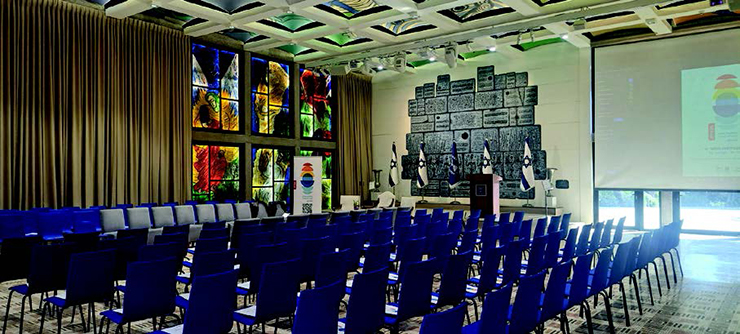
The décor at the residence models two complementary forms of leadership: otzmah kashah (hard strength) and otzmah rakah (soft strength). At Beit HaNassi, even the architecture speaks of these two forms of leadership. The entrance doors are made of heavy metal (otzmah kashah), projecting sovereignty and security. Inside, in the Jerusalem Hall where official ceremonies are held, one finds light, glass, and openness (otzmah rakah). The doors block while the windows illuminate. Three large stained-glass windows depict Yaakov Avinu, David HaMelech, and Eliyahu HaNavi, each of whom led both through otzmah kashah and otzmah rakah. Yaakov is described as an ish tam, yoshev ohalim. He was thoughtful and spiritually rooted. But he also wrestled with the angel, confronted Eisav, and rebuked his sons. His transformation into “Yisrael” suggests assertiveness and national leadership. David HaMelech led the nation militarily and fought Goliath. This is hard leadership. But he also composed T’hilim and unified the nation through inspiration rather than force. Eliyahu confronted the n’vi’ei Baal, rebuked King Achav, and was a fiery personality, yet he will be the messenger of the Geulah.
As I listened to the women of Osot Chayil, I realized that they, too, embodied these two forms of strength. The mothers and wives in that reception room carried their own versions of otzmah kashha and otzmah rakah – firmness in conviction, and softness in compassion. Israel’s strength does not reside only in its institutions, but in its people.
While one president insisted on davening in minyanim throughout the neighborhood, the shul in the Beit HaNassi has a daily minyan. Yitzchak HaLevi Herzog, the president’s grandfather and the first chief rabbi of Israel, authored the T’filah LiShlom HaMedinah. Reciting the T’filah in that shul is particularly meaningful.
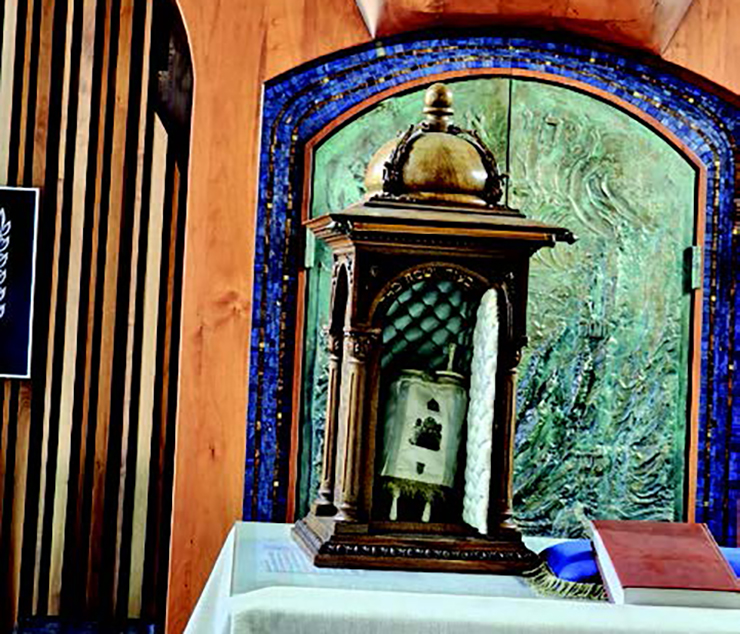
There is also a very small sefer Torah in a small aron kodesh with a story of its own. Jewish community leaders in Russia presented it to the Russian crown as a diplomatic gesture of loyalty during a time when Russian Jewry faced persecution. They had sought favor, hoping to soften a harsh decree. Unfortunately, it didn’t help, and many Jews were killed.
After the Russian Revolution, the sefer Torah arrived in Israel and was placed in the President’s Residence. During Zalman Shazar’s presidency, when his wife saw the sefer Torah, she began to cry. She explained that her father had been the one to bring the sefer Torah to the monarch of the Russian Empire. The sefer Torah had come full circle.
The President’s home may symbolize the State. But the future of that State rests in the courage of its families.
Suzie Steinberg, (nee Schapiro), CSW, is a native of Kew Gardens Hills and resident of Ramat Beit Shemesh who publishes articles regularly in various newspapers and magazines about life in general, and about life in Israel in particular. Her recently published children’s book titled Hashem is Always With Me can be purchased in local Judaica stores as well as online. Suzie can be reached at This email address is being protected from spambots. You need JavaScript enabled to view it. and would love to hear from you.