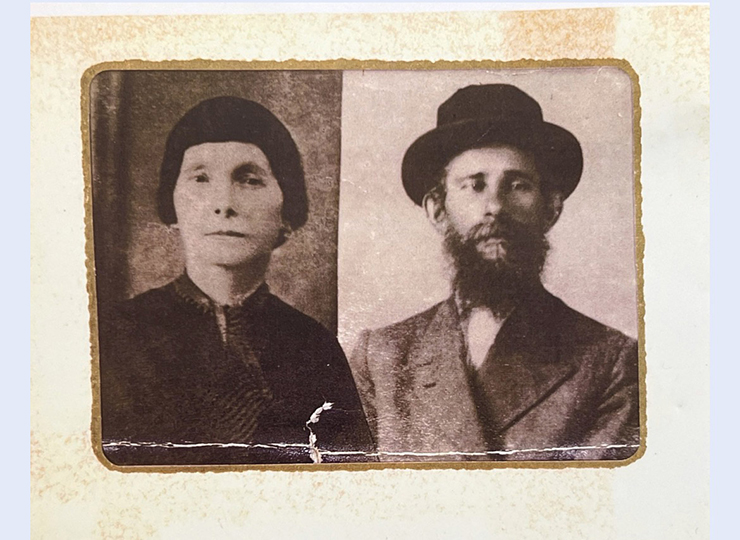
Finding my family’s history has truly been a remarkable journey. In 2024, when I began researching my family, I had no idea of the wealth of information I would uncover. My original goal was simply to document our escape from communist Hungary and the Soviet forces in 1956. That research ultimately culminated in an article, “Journey to Freedom: Our Family’s Escape From Communist Hungary.”
During my online research, I used Google to search for resources and articles regarding Hungarian refugees, spending hours reading through various historical materials. Completely unbeknownst to me, I innocently clicked on a link that would change everything. The very next day, I received a phone call from a woman identifying herself as Dr. H, a researcher from Homeland Security assigned to the President Dwight D. Eisenhower Library, located in Abilene, Kansas. Dr. H explained that my digital footprint had flagged an interest in Hungarian refugee records and wanted to know exactly what information I was looking for. I was utterly shocked to realize that a casual internet click was being monitored. Once I got past the initial surprise, however, we ended up having a deeply meaningful, in-depth conversation about my family’s escape.
After I explained how we escaped Hungary, Dr. H asked for the exact spelling of our surname to look it up in a specialized database. When I asked for details, she explained that they had compiled records of all Hungarian refugees who arrived in the United States under a special program championed through Congress by President Eisenhower, “Operation Safe Haven.”
Initially, the spelling of my last name yielded no results. But after a few moments of reflection, it dawned on me that when we took our citizenship oaths, the presiding judge dropped the second letter “Z” from our last name. My parents, terrified of jeopardizing our case, chose not to dispute the change. The judge went so far as to alter my first name from Laszlo to Leslie, declaring it a more appropriate American name.
When I provided our original surname with the Z, Dr. H successfully located my parents, my brother, and me on the passenger manifest of the USS General Walker. When I eagerly asked for a copy, she advised me that while the ship’s manifest was publicly available on Ancestry.com, the remaining 32 pages of my file, including a photograph, required a formal Freedom of Information Act request. She kindly sent me the link. Three weeks after submitting the online forms, a 32-page chronicle of my early life arrived by email.
The large file contained bilingual questionnaires, with English queries accompanied by Hungarian translations in brackets to guide refugees like my parents. It featured a stark photograph of me holding an identification board filled with letters and numbers, along with medical records, immunization cards, and copies of our naturalization papers. It was an invaluable historical treasure trove.
A few days later, the story took an unexpected turn when I received a phone call from an officer at the Pentagon who was conducting research for the Air Force. He inquired whether any of my relatives had traveled to the United States by air. At that moment, I did not know that my cousin and her parents had indeed arrived by plane. After this experience, I wrote to all my first cousins and told them they could also fill out the same form using the link, and perhaps they would uncover things about themselves or their parents.
Uncovering family history is a journey shaped by deliberate research, family interviews, and occasionally, pure chance. My own path was paved with a blend of historical inquiry and profound mazel (luck), leading me to second cousins I never knew I had. While the chaos of World War II fractured so many families and scattered them across the globe, I remain struck by the beautiful coincidence that brought us back together, all because I walked into my local shul one day.
My wife, Elaine, and I had just returned to Florida after spending six beautiful, amazing weeks in Israel with our daughter, son-in-law, and grandchildren. Adjusting back to a routine and dealing with much jet lag, I headed to shul for morning services. After services ended, a friend approached me, eager to introduce me to a newcomer in the community, Mendy Katz, from Hillcrest, New York. As soon as I said my name, Mendy’s face lit up. He immediately claimed we were related, suggesting we might be second cousins. I listened politely, but in the back of my mind, I remained skeptical.
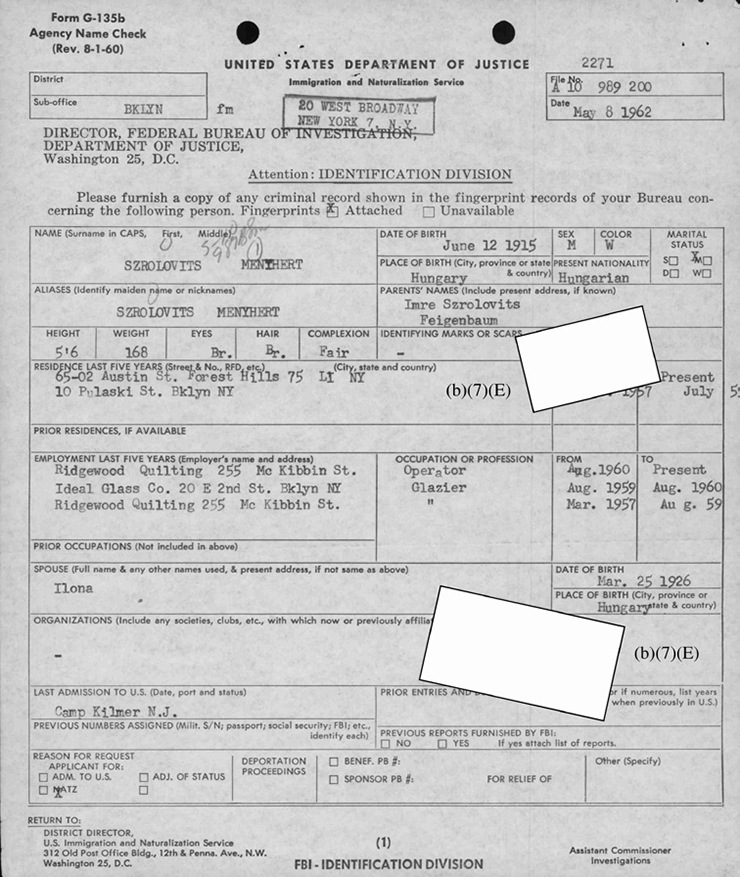
Once I finished davening, I made my way to the keilim mikvah at the back of the synagogue parking lot. To my surprise, there was Mendy again. Reading the lingering doubt on my face, he smiled and said, “If you don’t believe me, let’s call my brother Leiby in Brooklyn. He’s the real family historian.” Mendy placed the call and asked him directly, “How are we related to the Srolovits family?” Leiby didn’t hesitate for a second. He explained that their grandfather, who was a Feigenbaum, had a sister in Nyírbátor, Hungary, the exact town where I was born. Leiby went on to mention that one of the children in that Srolovits family was named Menyhert (Menachem Zev). At that moment, I was completely speechless. My father, a”h, was Menyhert, known to everyone as Manny. All I could think was, is it truly possible? Have I stumbled onto relatives now, after 78 years of not knowing if any other members of our family survived the horrors of the war? Many years ago, my brother had searched the Yad Vashem archives, which mistakenly listed my father as deceased when he was actually very much alive. To uncover this connection after a lifetime of silence feels like an absolute miracle.
After speaking with Mendy and Leiby, a single question continued to haunt me: How could I uncover the proof that my grandmother’s name was truly Feigenbaum? The facts I knew about my grandparents were few but deeply rooted: They were a devout Kaliver Hasidish family. My grandfather, a man I never had the honor to meet, had eleven children: one child from his first marriage, whose wife died at a young age, and ten children from his second wife. My father, z”l, was the oldest of those ten siblings. The war took a profound toll on the vast family we were meant to have. Only four of the eleven children survived, emerging from the horrors of the Holocaust as orphans with no parents left to comfort them.
Leiby Katz suggested I reach out to his cousin in Lakewood, Rabbi Dovid Unger. When I called the esteemed Rabbi, he not only verified the Feigenbaum name but also shared a piece of his family’s history: His grandfather had left Hungary for Czechoslovakia in 1922 with his seven children. Around 1938, sensing the ominous rumblings in Germany, the family moved to Cleveland, Ohio, where Rabbi Unger lived before relocating to Lakewood to head a kollel of ninety students. Hearing “Cleveland, Ohio” immediately struck a chord, bringing back memories of my father flying there to visit relatives.
The next detail Rabbi Unger shared completely overwhelmed me. He told me that as my grandmother was being forced from her home, never to be seen again, she left her children with one final, haunting command: “Children, never forget about Shabbos, and always keep it.” Hearing those words brought tears to my eyes. I found myself transported back to that devastating moment, imagining what it was like to stand among her eleven children and hear her final words.
Despite the growing certainty from my conversations with Mendy, Leiby, and Rabbi Unger, I wanted to consult my family. I reached out to my first cousins to see what they could recall. My cousin, Allen Szrolovits, noted that finding any old documents bearing the Feigenbaum name would be the ultimate, undeniable proof.
A few hours later, the answer hit me like a ton of bricks.
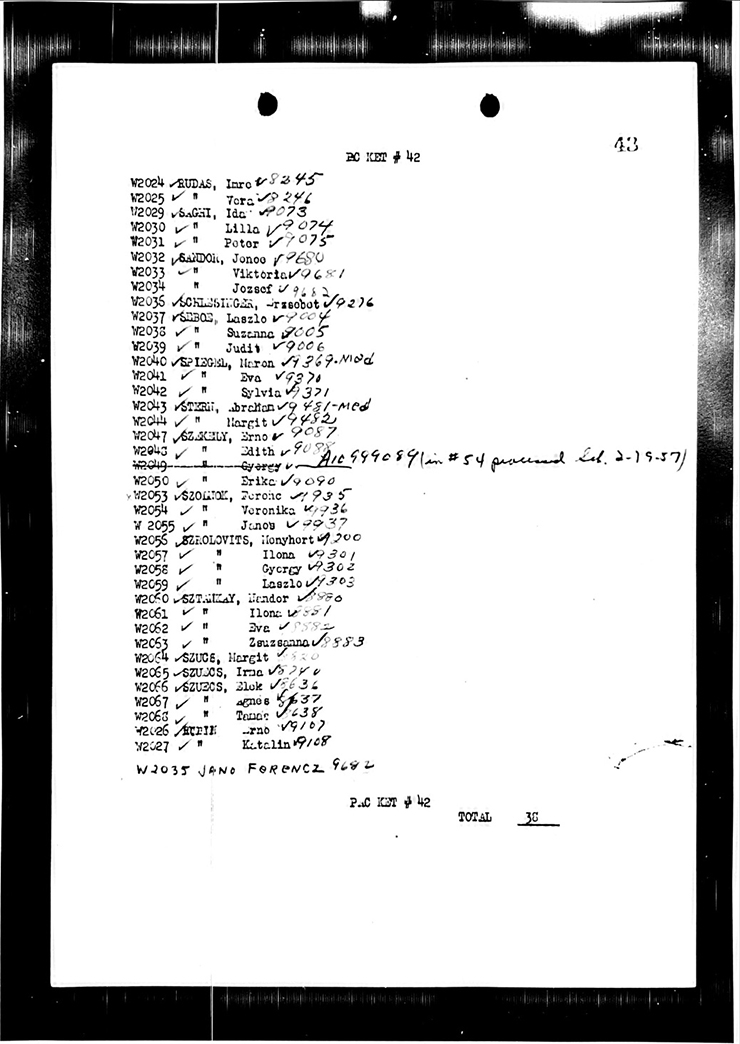
Months earlier, I had requested my father’s government records via the Freedom of Information Act (FOIA), using a link provided by Dr. H. To do this, I created a dedicated email account for my deceased father and submitted his death certificate. Four weeks later, I received a 52-page PDF file, which even included a photo of him I had never seen before. I opened the PDF to review it once more. There, on page 42, was the definitive proof we were looking for. On the form my father filled out when we were taken to Camp Kilmer, New Jersey, for processing, he had clearly written his mother’s maiden name: Feigenbaum. The mystery was finally solved.
Mr. Leslie Srolovits is a retired banker/technology officer. He can be reached at This email address is being protected from spambots. You need JavaScript enabled to view it..