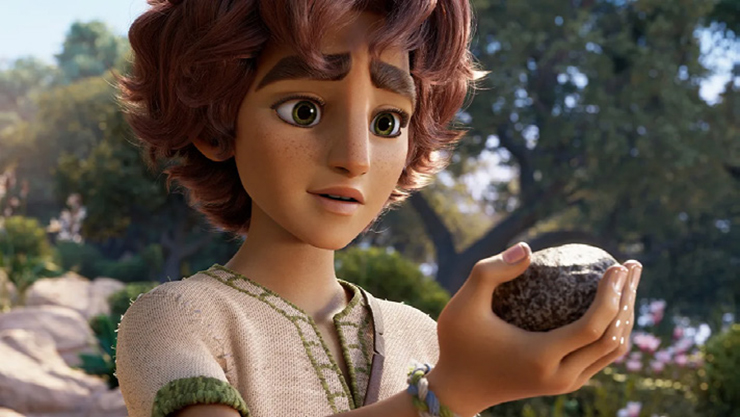
It has been 25 years since a major production studio released a movie based on a biblical story (assuming we are only considering the original Bible). That changed last month with Angel Studio’s release of the full-length animated musical David, which tells the story of Dovid HaMelech. If you are someone who goes to movie theaters, I highly recommend taking your children to see this one.
If you are like me, you might normally be apprehensive about a Christian-made retelling of the story of one of Judaism’s greatest heroes. To be honest, throughout the entire two-hour runtime of this film, I was looking for any hints of ideas or concepts that would not align with Jewish thought. Although I looked hard for them, they are not really there. The most you can say is the overemphasis on David being from Bethlehem. Aside from that, there isn’t much overt linkage to future individuals.
With that out of the way, let’s discuss the positives and negatives of this movie. The most obvious positive is that David really does stick to the story as told in Sefer Shmuel. While there are a few added elements to make it suitable for children—such as comic relief from some of David’s brothers, an added rivalry between David and his oldest brother, and the importance of David’s mother (who isn’t even mentioned in the Navi)—other than that, the film remains very true to Sefer Shmuel.
The story of Dovid HaMelech also lends itself well to being a musical, since Dovid was a composer and musician. The music is extremely well done. Because music is a major component of Dovid’s story, the songs aren’t placed in spots where they wouldn’t normally make sense in a musical. Dovid plays music to calm Shaul HaMelech, and he is asked by his mother to play something new, implying that everyone knows he is a musician. These aren’t trite religious songs either—they are strong, memorable pieces. There is even a madrigal-style song that incorporates all the major songs previously sung in the movie into one (think “One Day More” from Les Misérables). My eight-year-old daughter and I still listen to the soundtrack and are trying to learn the words to every song.
While the words of Tehilim are clearly found in the lyrics, they aren’t simple translations; they fit nicely into the message the original Psalm was trying to convey. For example, one song repeated throughout the movie is “I will not be afraid,” which echoes the message in Perek 23: “Though I walk through the valley of the shadow of death, I will fear no evil, for You are with me.”
Unlike if Disney had made this movie, there are no talking animals, though some of the animals—especially Dovid’s sheep—are given emotions. After all, it is a children’s movie.
Many of the characters are perfectly portrayed. The most obvious is Shaul HaMelech. When we walked out of the theater, my daughter asked me if Saul was a good guy or a bad guy, which tells me that they absolutely nailed his character. Often in children’s movies, characters are either good or bad, and the fact that they were able to convey to a younger audience a more nuanced version of a very complicated person shows that they knew what they were doing. Yishai (Jesse), Dovid’s father, is mostly quiet, but when he speaks, he is perceived as the wise elder. Yonatan’s character and his friendship with Dovid are handled very well, building up the relationship to the point where Yonatan’s death is very emotional.
The one questionable casting choice is the way Shmuel is portrayed. He is given a thick European accent that is not how someone who lived his entire life in ancient Israel would have sounded. Even though Shmuel is a relatively minor character in the movie, it just didn’t seem like the right decision.
There is one other aspect of the movie that may be off-putting to some in the Orthodox Jewish world: the use of the Shem HaShem occurs several times throughout the film, including in a few of the songs. When Shmuel sings it, it is part of two full p’sukim that were said, but other times it is used as part of a regular sentence. In one case, it is the use of Sha-kai. So, just be aware that this happens.
For those wondering how they handle certain parts of Dovid HaMelech’s life to make them kid-friendly (and you know which stories those are), they are not in this movie. The timeline of the film covers from his anointment up until Shaul’s death and David becoming king. So stories involving Batsheva and Avishag are not covered. Even Michal is not mentioned.
All in all, this was a positive experience. If we want to see more biblical stories made into full-length, well-done musicals with impressive animation and kept true to the text, we should consider supporting them when they are made. How many of us were waiting for Disney to make an Esther movie? Well, maybe if this movie is successful, that could be next. And if you are waiting for this to come out on a streaming service, know that Angel Films has its own platform, so it won’t be available on Netflix or Hulu in the future. But if you’re interested in the soundtrack, it is available everywhere now.
Izzo Zwiren is the former host of the Jewish Living Podcast. Follow him and his brothers on their health journey on their YouTube Channel, Brotherly Lovehandles. Izzo lives on Long Island with his wife and three adorable, hilarious children.