If you’re following developments in the war between Ukraine and Russia, then you know that there has been an amazing turn of events in the last several months. Ukraine had been losing huge swaths of land, but suddenly it had managed to turn the tide. Now it is not only holding on to its land but retaking land that was lost. And in the process, literally every day, Ukraine is inflicting painful attacks against the Russian enemy.
What turned the tide in favor of Ukraine? Their use of very advanced drones. These weapons can make precision strikes against strategic targets many hundreds of miles away—even sites that were considered secure because they were protected by Russia’s most modern defenses.
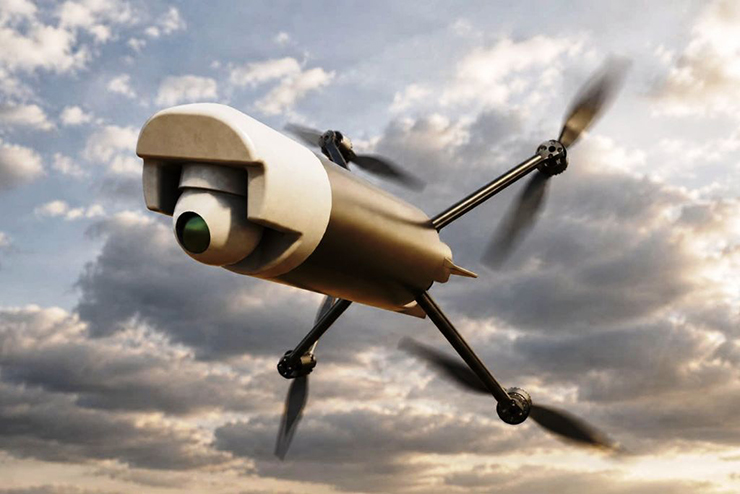
Israel has been watching these developments very closely because it realizes that there is a danger that its enemies may attempt to make the same kinds of attacks being used to batter Russia now. So, to help keep Israel safe, it has developed a new aerial system to “swat” enemy drones from the skies. That system is called the Iron WASP, and although many details are still under wraps, some were very recently unveiled to the public.
Drone Swatter
The WASP is the latest brainchild of Rafael Advanced Defense Systems, which is recognized not only as one of Israel’s premier defense firms but also as one of the best in the world. According to AI Overview, “Rafael is highly respected for its air and missile defense systems and is sought after globally for its cutting-edge, battle-tested military technology. It is ranked among the top 35 defense firms in the world by the Stockholm International Peace Research Institute.” By the way, this assessment is showing up in the company’s financials; Rafael recently reported record-breaking sales as well as a large increase in both profits and backlog.
Search and Destroy
The Iron WASP was developed in cooperation with Israeli aerospace firm SuperUAV, another highly regarded Israeli firm. It was engineered to be able to hunt down and neutralize explosive drones, which have become one of the most dangerous threats on the battlefield, according to Rafael.
One of the benefits of the WASP is its design, which enables it to be easily integrated with existing military vehicles. This is important because it gives ground forces a mobile and rapidly deployable counter-drone capability. “It can move with troops rather than sit fixed at a static installation waiting for a threat to come to it,” the company explains.
Unfortunately, Israel has to deal with threats generated from a variety of sources. One of these is the terrorist organization Hezbollah. “Hezbollah is trying to turn drones, fiber-optic control lines and small weapons into a constant tool of attrition against IDF forces,” says Mati Shosani, CEO at SarElMedia and director of operations and host of the Jerusalem-based news bureau TBN Israel. The WASP will be utilized to thwart that threat and others like it.
According to AI Overview, the WASP was designed with state-of-the-art technology that will protect maneuvering ground forces from incoming enemy drones. And since it is built directly on armored combat vehicles, it will be able to deploy interceptor drones while those vehicles are in motion, eliminating the need for troops to stop and set up defensive equipment.
Although Rafael has not yet released important details about the WASP, news sources are speculating that the fact that the company has said anything about this publicly is an indication that its development is not only well underway but that it could be officially introduced in the relatively near future.
Changing Quickly
The WASP’s introduction is a very timely and important development because warfare is changing at an unprecedented rate, and arguably, drones are at the forefront of those changes. The website ahblicklive.com recently explained why they are quickly becoming the weapon of choice.
“Explosive drones are inexpensive, small, increasingly autonomous and devastatingly effective against armored vehicles, logistics convoys, and frontline troops. They have emerged from Ukraine to the Middle East, dramatically altering the logistics of ground warfare in ways that defense planners are still attempting to fully reckon with. Traditional air defense systems built to track fast-moving jets and ballistic missiles were simply never designed to deal with the swarm tactics, low radar signatures, and sheer volume of small UAV threats that modern conflicts have thrown into the mix.
“That gap between existing capability and emerging threats is precisely the market space that the Iron WASP is designed to fill, and Rafael’s decision to partner with SuperUAV—a firm with extensive expertise in unmanned aerial systems—suggests that Israel intends to fight the drone threat on its own terms, using cutting-edge UAV technology to defeat UAV technology.”
In addition to playing a vital role in Israel’s battlefield activities, the Iron WASP will also send a clear message of a different kind: that Israel has faced and coped with more aerial threats than any other country and that it is now ready to deal with the latest one: drones.
At the end of June, Israel National News reported that Hamas is preparing for a new war with Israel—actively recruiting for its elite Nukhba units, ramping up training, and manufacturing drone components, among other efforts. And Hamas is not alone; it is certainly joined by Iran, Hezbollah, the Houthis, and other bad actors that are hostile to Israel.
Unfortunately, even a brief glance at the geopolitical situation is very sobering. This reality is what makes staying ahead of enemies so crucial. The Iron WASP is not a perfect solution that will resolve all of the challenges confronting Israel. At the same time, it is an important step toward achieving that objective. And with Hashem’s help, Israel will defeat all of its enemies.
Sources: AIOverview.com; ahblicklive.com; israelnationalnews.com; tbnisrael.com