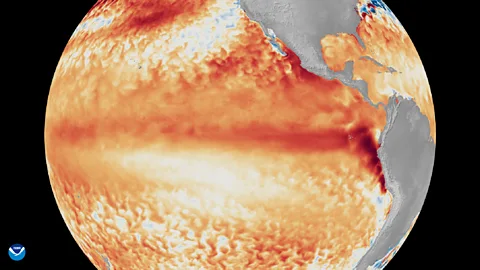
Months ago, meteorologists forecast that a Super El Niño would develop this summer, and their prediction was right on target. Let’s hope it falls apart quickly because, if not, there will be consequences for the entire world.
El Niño is a natural weather phenomenon that causes surface temperatures in huge parts of the Pacific Ocean to be warmer than average. According to AI Overview, this occurs every two to seven years and impacts global weather, resulting in droughts in some areas, increased rainfall in others, and, in still others, warmer-than-normal weather. In the past, El Niños have led to exceptionally hot weather as well as intense and prolonged droughts.
Meteorologists say that an El Niño has already formed in the southern Pacific Ocean — much earlier in the summer than originally forecast. But that’s not the whole story. Now it’s being reported that a separate and humongous heatwave has developed in the northern Pacific Ocean.
“Weather experts are warning that these two heatwaves will combine to form a Super El Niño, and that it will be unlike anything we have ever experienced,” The Economic Collapse Blog reported. In simple terms, a “Super El Niño” is an El Niño on steroids. Some experts are warning that if it does develop, it could cause trillions of dollars in damage to the global economy.
Forecast Is on Track
Those hoping that the many forecasts of a looming Super El Niño were mistaken were very disappointed on June 11. That was when the National Oceanic and Atmospheric Administration (NOAA) officially confirmed that an El Niño had developed and would make a major impact on global weather patterns. Experts used that occasion to repeat their predictions that conditions were in place for it to intensify and possibly reach historic levels. They added that, in this scenario, extreme weather events that develop around the world will be exacerbated.
Crop Yields Impacted?
As one would imagine, experts are paying close attention to this El Niño, and they’ve noticed something unusual about it. “Most El Niños begin in the fall,” AccuWeather Senior Meteorologist Chad Merrill said. “This one is developing much earlier and faster than expected.” Some experts believe this is an indication that, while a few regions may see higher crop yields, the overall impact on the global economy is expected to be overwhelmingly negative.
In addition to the physical dangers that a Super El Niño would generate, it also can be very costly financially, The Economic Collapse Blog reports. And if early indications are an indication of what’s coming, this one could be a doozy. Even a quick look at the past shows how costly they can be. The 1982-83 Super El Niño led to $4.1 trillion in global income losses, and the 1997-98 Super El Niño cost $5.7 trillion, according to one study. Those losses resulted from damage caused by intense heatwaves, floods, droughts, tornadoes, and wildfires.
What would the losses be if a Super El Niño impacts the U.S. in 2026? AI Overview said that by 2032, it could cost the U.S. more than $1.8 trillion in long-term economic damage and lost productivity.
But others estimate that the damage would be much greater. For example, “The current forecasts imply that the El Niño that has just formed could become the costliest one on record,” said Justin Mankin, a Dartmouth geography associate professor who studies El Niño’s economic impacts.
According to The Economic Collapse Blog, if Mankin is correct, this El Niño “potentially may cause more than $10 trillion dollars of damage to the global economy. In the months ahead, global food production could drop precipitously, supply chains could be severely disrupted, and we could witness an endless series of extremely destructive weather disasters.”
The combination of these would slow down global economic growth and impact agriculture, infrastructure, and supply chains. In addition, there may be a wide range of weather-related global disasters, ranging from devastating floods and crop-destroying droughts to plummeting fish populations. Experts who have studied El Niños say that they also may usher in a variety of other and seemingly unrelated problems, such as an uptick in tropical diseases worldwide.
The strongest El Niño on record was the Super El Niño of 1877 and 1878. Not only was it deadly, but so were the brutal conditions that preceded and followed it in many areas. An estimated 50 million people perished during the Great Famine of 1876 to 1878, and as shocking as this number is, it was even much worse than it sounds, considering that the population of the world back then was much lower than it is now.
A Multiplier Effect?
USA Today very recently quoted an email from Saskia van Gendt, Chief Sustainability Officer with supply chain management firm Blue Yonder. In that email, she writes that the developing Super El Niño, combined with the current Middle East conflict, “could have a multiplier effect on wheat, rice, and corn, which are already at risk due to reduced fertilizer availability during the planting season... This will result in near-term shortages and price increases, along with a prolonged impact, since these crops are used as animal feed and in processed foods.”
AI Overview says a Super El Niño would not only bring milder winters to the North and West Coast, but also “turbocharge extreme weather globally, causing devastating agricultural losses, supply chain disruptions, and food inflation.” As noted above, some estimates of economic damages are shockingly high.
Meteorologists have not made very detailed weather forecasts for the U.S. for the summer and beyond, but basically what they have said is that wild weather could lie ahead — and that’s why prepping makes sense. You’ll find a lot of useful information online about how to plan for weather extremes such as severe droughts, heatwaves, flooding, and power outages. You will also find information about safeguarding your property, e.g., inspecting your roof and clearing gutters to prevent flooding. And there will be other important ideas, such as what items to have in an emergency medical kit and anticipating possible surges in food prices and empty shelves in supermarkets.
As we know, weather forecasts sometimes miss the mark, and that could happen now, too. Still, when even mainstream agencies are making such extreme forecasts, it makes sense to be on the safe side — just in case!
Sources: AI Overview; accuweather.com; msn.com; preventionweb.net; theeconomiccollapseblog.com; usatoday.com