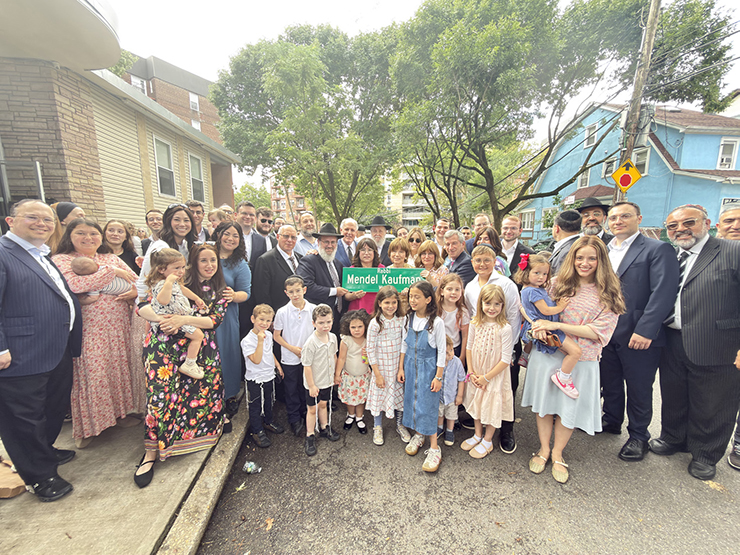
A new street sign bearing the name “Rabbi Mendel Kaufman Way” was unveiled Sunday morning, August 23, at the corner of Daniels Street and Pershing Crescent in Briarwood, honoring the longtime Rav of the Young Israel of Briarwood, who passed away in 2020 at the age of 85, and his decades of service to the community.
Rabbi Kaufman’s family joined rabbanim, congregants, community leaders, and longtime Briarwood residents outside the Young Israel of Briarwood, where he served as Rav for 46 years. New York City Council Member James Gennaro, who sponsored the co-naming legislation, recalled a leader whose work extended far beyond the shul. Rabbi Kaufman tutored children, visited the sick and elderly, helped families in need, and ensured that the synagogue remained a home for prayer, Torah learning, and community life.
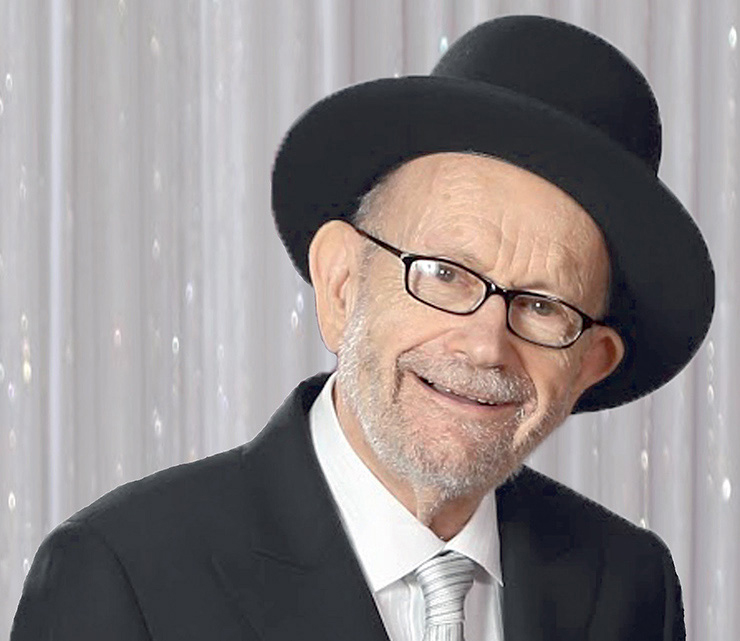
Rabbi Kaufman also served the broader Queens Jewish community through the Vaad Harabonim of Queens and as a mediator in the Queens Beis Din, where he was known as a natural peacemaker. “When we co-name a street, we are making sure that someone who helped shape a community remains part of its story for generations to come,” Gennaro said.
Rabbi Herschel Welcher, Rav of Congregation Ahavas Yisroel and president of the Vaad Harabonim of Queens, said the dedication was not only a recognition of the past. The truest biography of a tzadik is found in his deeds. He described Rabbi Kaufman as a great talmid chacham, a humble man, and an ohev Yisrael who worked tirelessly for others. “Each time that we pass this corner and see the sign, we should stop to think for a moment about the ideals for which he lived,” he said.
Uri Kaufman recalled arriving in Briarwood 52 years earlier, almost to the day, when his father piled the family into “a beat-up old Buick” and drove to the shul where he would become Rav. “My dad loved this kehillah. He loved this shul, and he loved New York City,” Uri said. A Lower East Side native, Rabbi Kaufman retained a deep love for the city. “Now there is a little part of that city that is forever his.”
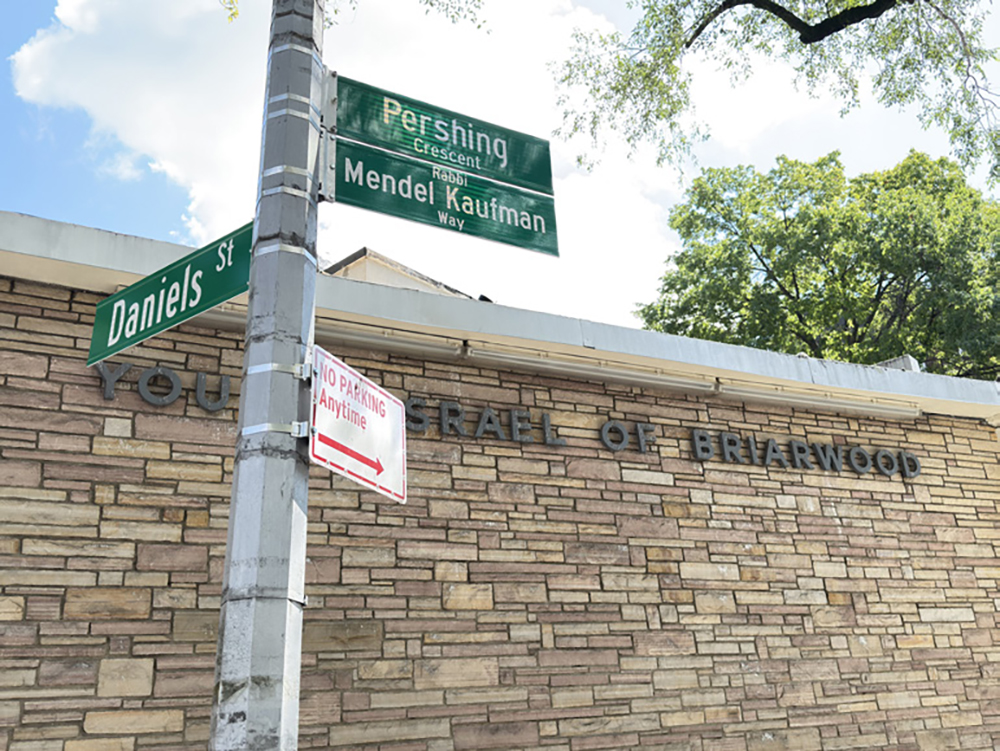
Rabbi Eliyahu Kaufman said his father, who never sought honor, likely would have chuckled at seeing his name on a street sign. Its value, he explained, is in connecting future generations to the mesorah his father transmitted. “He was always worried about the individual person,” Rabbi Eliyahu said. “In a lifetime of working for the individual person, you end up impacting the masses.”
One example took place on the very block where the sign now stands. Although the early minyan began at 6:30 a.m., Rabbi Kaufman arrived a half-hour early for years to help an elderly congregant cross the street. He also quietly followed a child home from the school bus each day after noticing that the youngster returned to an empty house. Both were examples, speakers said, of the concern he showed for individuals.
Rabbi Siman-Tov Yanetz, Rav of the Bukharian Jewish Congregation of Briarwood, housed in the basement of the Young Israel, recalled how Rabbi Kaufman welcomed newcomers. On Chanukah in 1993, a Jewish immigrant newly arrived from Russia knocked on his door. Rabbi Kaufman gave him a menorah, candles, and an envelope containing $35 to help him begin his life in Briarwood. He also spent years teaching Gemara to a public school student who first approached him at 17. At Rabbi Kaufman’s first yahrzeit, that student completed a Siyum HaShas in his rebbi’s memory.
Rabbi Yisrael Kaikov, a well-known Yeshiva Sha’arei Zion rebbe who now fills Rabbi Kaufman’s former role at the Young Israel, never met him. He first encountered his influence through a young student who cried upon learning of the Rav’s petirah, even though the child did not daven in Rabbi Kaufman’s minyan. Rabbi Kaikov said the reaction demonstrated how Rabbi Kaufman’s influence extended beyond those he directly taught.
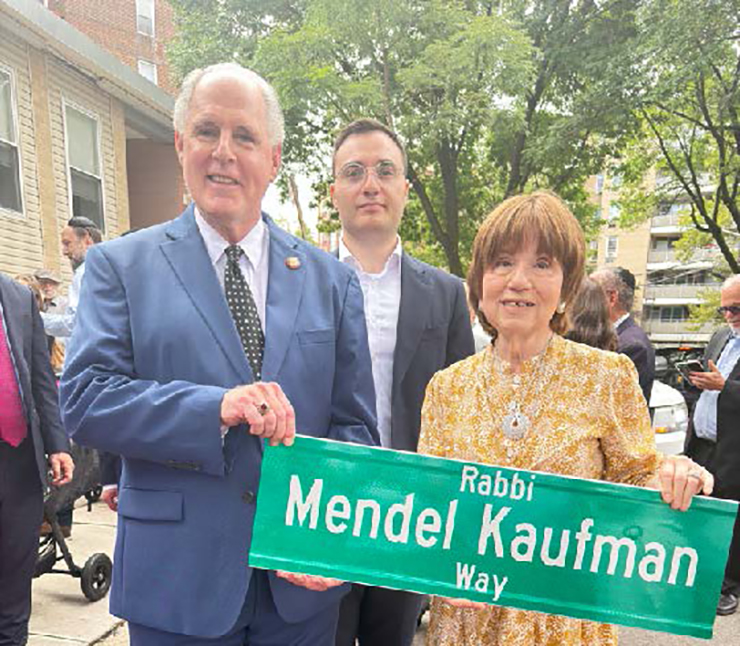
Rabbi Kaikov also commented on the wording of the sign. It says “Way,” he noted, rather than street or avenue, a reference to Rabbi Kaufman’s way of Torah, kindness, and concern for others. Rabbi Shlomo Nisanov similarly described him as “a mensch par excellence” whose vision helped the Young Israel become a center with multiple minyanim, Torah learning, and Jewish life.
Young Israel vice president Jacob Davidov recalled Rabbi Kaufman’s knowledge and humility. When asked a question he could not immediately answer, the Rav would say, “I’m not sure,” research the matter, and call a day or two later with an answer. “He did not need to impress people,” Davidov said. “He simply wanted to help them.”
After Gennaro recognized the Rebbetzin, the Kaufman family, community organizers, and Queens Shmira volunteers in attendance, the family took hold of the cord. The crowd counted down from three, the covering fell, and Rabbi Mendel Kaufman Way was revealed to applause.
Shloime Zweig noted that Rabbi Kaufman had opportunities to move to larger, more prominent positions but chose to remain with his community. Yonah, a grandson, spoke about how an act directed toward one person can benefit an entire family or community. Malkiel Gavrielov, one of Rabbi Kaufman’s early Bukharian students, called him a spiritual father and recalled his Torah teaching. Another grandson said Rabbi Kaufman’s lasting legacy was not the street sign itself, but the Torah lived and transmitted by those he influenced. Rabbi Kaikov concluded the indoor remarks with a brief d’var Torah on humility in leadership.
The newly unveiled sign now stands across from the shul where Rabbi Kaufman served for nearly five decades, commemorating his years of leadership and his influence on generations of Briarwood families.