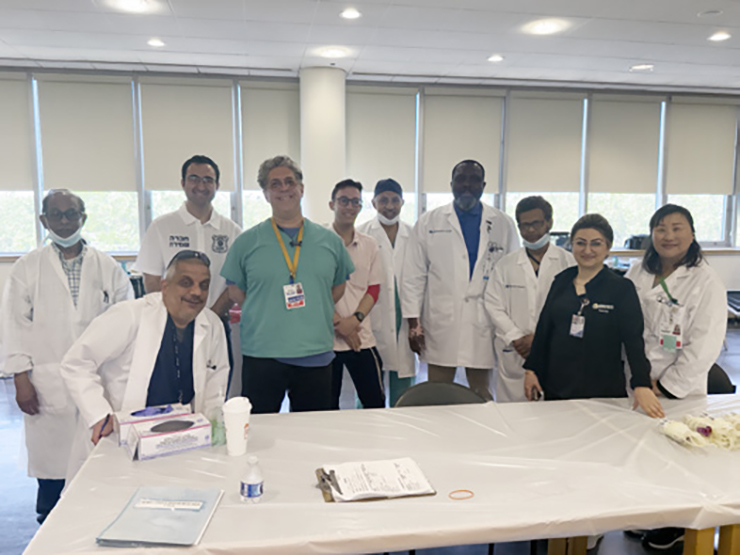
More than 50 donors rolled up their sleeves on Monday afternoon as students, faculty, and community members gathered at Lander College for Men for a blood drive held in conjunction with Maimonides Medical Center and the New York Blood Center.
What began as a student-led initiative quickly developed into a meaningful campus-wide effort centered on one simple mission: saving lives. Held on the fourth floor of the college building on 150th Street in Kew Gardens Hills, the drive was spearheaded by student Ari Siegel, who worked closely with the administration to coordinate the event. Organizers described a steady turnout throughout the afternoon, with students and community members continuously arriving to donate.
For Siegel, the motivation behind the initiative came from a simple realization. “We have the ability to make a real difference for people who are going through difficult medical situations,” he said. “If donating blood can help save someone’s life, then it’s something worth doing.”
Although Lander College had hosted blood drives in the past, this marked Siegel’s first time organizing one himself. He credited Rabbi Ariel Kopitnikoff, Dean of Students at Lander College for Men, for his encouragement and guidance throughout the planning process.
Siegel also expressed appreciation to the teams from the New York Blood Center and Maimonides Medical Center for helping coordinate the drive and navigate the many details involved in running a successful donation event.
Special recognition was given to Dr. Martin Bluth, Chief of Blood Transfusion and Donor Services at Maimonides Medical Center, whose experience and direction helped ensure the drive ran smoothly from start to finish.
Many participants said the drive gave them an opportunity to contribute to something larger than themselves at a time when hospitals nationwide continue facing periodic blood shortages. A single donation can potentially help multiple people in need.
By the end of the drive, organizers said the strong turnout reflected not only the generosity of the student body, but also the broader sense of communal responsibility deeply rooted within the Queens Jewish community.
For Ari Siegel, the success of the afternoon was measured not by numbers alone, but by the possibility that each donation could one day save a life.
By Shabsie Saphirstein