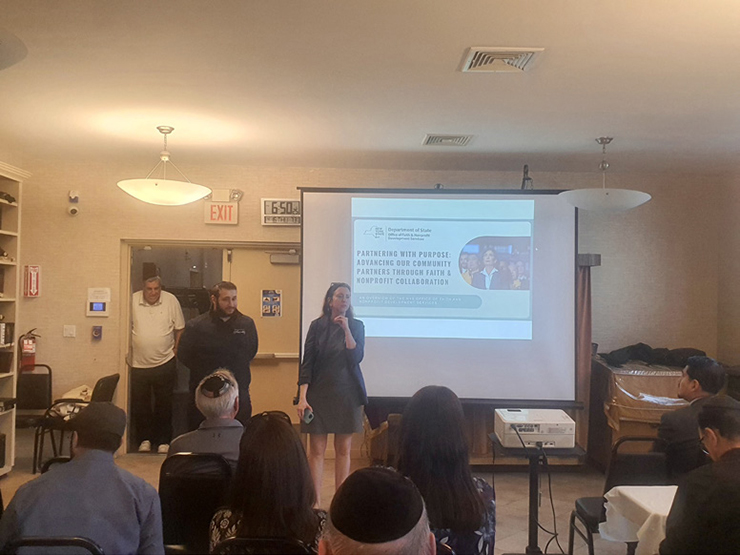
On Thursday night, April 16, community leaders and school administrators gathered at the Young Israel of Hillcrest for a State Resource Workshop. The meeting addressed a primary concern for the local community: how to better protect non-public schools and religious institutions. Hosted by Assemblymembers Nily Rozic and Sam Berger, the event brought together state agencies and Jewish organizations to discuss practical security tools. The objective was to provide attendees with a clear understanding of the grant programs and safety resources available to their institutions.
Assemblywoman Rozic opened the session by emphasizing that security requires a coordinated effort between the government and local organizations. She stressed that no single shul or school should have to manage safety concerns in isolation. The discussion then shifted to the practical substance of security planning. Representatives from Teach NYS, the Community Security Initiative, and the Jewish Community Relations Council of New York (JCRC-NY) provided detailed guidance on risk assessments and planning protocols. A central part of the discussion involved navigating the process to access state funding, which many institutions find difficult to manage on their own.
Assemblymember Berger noted that legislative work in Albany continues regarding these protections. He explained: “Assemblymember Rozic and I are constantly pushing for more funding and better access.” He added that a major priority is streamlining the grant process so that institutions do not face long delays between applying for and receiving the funding they need to stay safe.
State agencies were also represented, including the Department of State’s Office of Faith & Non-Profit Development Services and the Division of Human Rights. Their involvement highlighted that state systems are accessible to community leaders who need guidance on compliance and development.
The workshop moved into specific details regarding grant applications and timelines. For many attendees, the opportunity to speak directly with agency representatives provided much-needed clarity on bureaucratic requirements. There was also a broader conversation regarding the nature of security today. Organizations such as StandWithUs and the Auschwitz Jewish Center Foundation addressed the reality that security is not just about physical barriers: It also involves education, awareness, and confronting the specific challenges currently facing Jewish communities.
The evening concluded with a Q&A session where attendees asked about security upgrades and grant eligibility. The answers provided were direct, focusing on the practical steps needed to secure school buildings and houses of worship. As the meeting wrapped up, Assemblywoman Rozic thanked Governor Kathy Hochul and key advocates – including Howard Pollack of JCRC-NY, Avi Posnick of StandWithUs, and Michael Cohen of the Auschwitz Jewish Center Foundation — for their consistent work in advancing these security efforts. The takeaway for those in attendance was that while the work is ongoing, there is a serious, coordinated effort to ensure Queens institutions are not left to handle these challenges alone.
By Shabsie Saphirstein