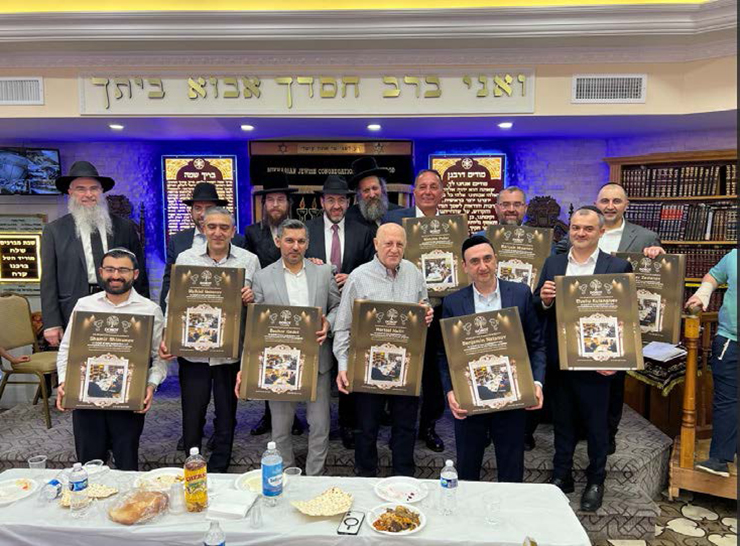
On Sunday evening, June 7, community members gathered at the Young Israel of Briarwood to celebrate a siyum on Maseches Moed Katan. The evening carried a special feeling, with fathers and sons sitting together and proud wives and mothers seated behind the m’chitzah.
Rabbi Simantov Yanetz, rav of the Bukharian Congregation of Briarwood, opened the evening by welcoming the crowd and placing the celebration in the context of the shul’s broader mission. “Our shul is a place of Torah and only Torah,” he said.
He noted that the siyum reflected not only one night of celebration, but a sustained commitment to learning. For some of the men, this marked their second siyum; for others, it was their fourth. Several participants were also celebrating the completion of Maseches Megillah.
Malkiel Natanov, a community member, spoke first and expressed gratitude for the opportunity to begin and complete the masechta. “Thank You, Hashem, that You let us start and finish it,” he said.
He also thanked Rabbi Yanetz, Rabbi Erps, and all those who consistently supported the learning. Drawing on Pirkei Avos, he noted that a person must look inside the flask. Moed Katan may appear to be a short masechta, he explained, but inside it is vast. It deals with two major areas – Chol HaMoed and Aveilus – both of which are times of transition. Through those topics, the Gemara teaches a person how to live with dignity.
Mr. Natanov also cited the words of the prophet Yeshayahu that all of one’s children will be students of Hashem and there will be great peace. Talmidei chachamim, he said, are builders. They build shalom in a person’s life.
“Torah always gives us life,” he said. “And Torah is real simchah!”
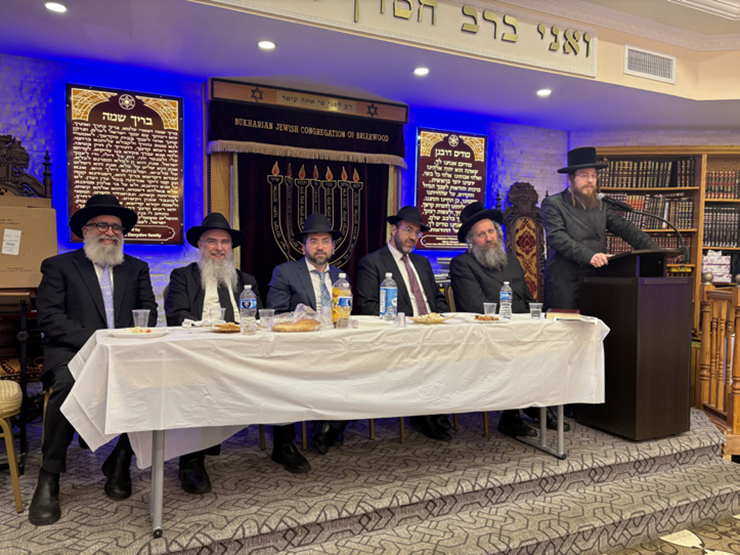
Rabbi Akiva Ruttenberg, founder and CEO of Emet Outreach, continued the evening’s message by reflecting on the atmosphere in the room.
“There is k’dushah in this room,” he said. “We feel the kavod haTorah here.”
Rabbi Ruttenberg credited Rabbi Yanetz with creating an environment of Torah. He noted that Pirkei Avos teaches that the crown of Torah is the greatest crown, and this mishnah is reminding us that Torah is accessible to every Jew. It was given at Har Sinai to each and every one of us.
He added that it was especially beautiful to celebrate a siyum on Maseches Moed Katan in a shul that represents both Torah and midos tovos.
Rabbi Nisan Erps, an important teacher who travels from Williamsburg every Tuesday night to teach in the shul, then shared a thought connected to the idea of an eidah. The Gemara asks how we know that ten people are needed to form an eidah. That lesson is derived from the episode of the M’raglim. Although there were 12 spies, two were righteous, while the other ten were referred to as an eidah.
Rabbi Erps asked why such an important concept is learned from such a negative incident. He shared his rebbi’s teaching that for every day that the spies were in Eretz Yisrael, B’nei Yisrael were punished with a year of remaining in the Midbar. Yet every good thing Hashem does for us is 500 times greater than punishment, a lesson that can also be learned from the episode of the spies.
He also cited the Klausenberger Rebbe, who taught that when a person has one fixed hour of Torah learning each day, it is considered as if he learned for half the day and worked for half the day.
The featured guest speaker, Rabbi Label Lamm, a well-known orator, spoke with great emotion about the significance of learning Torah together.
“I am overwhelmed and amazed,” he said. “We are all clutching the same mitzvah here. When people are learning together, this forms the closest relationship. The closest relationship we have with Hashem is through Torah.”
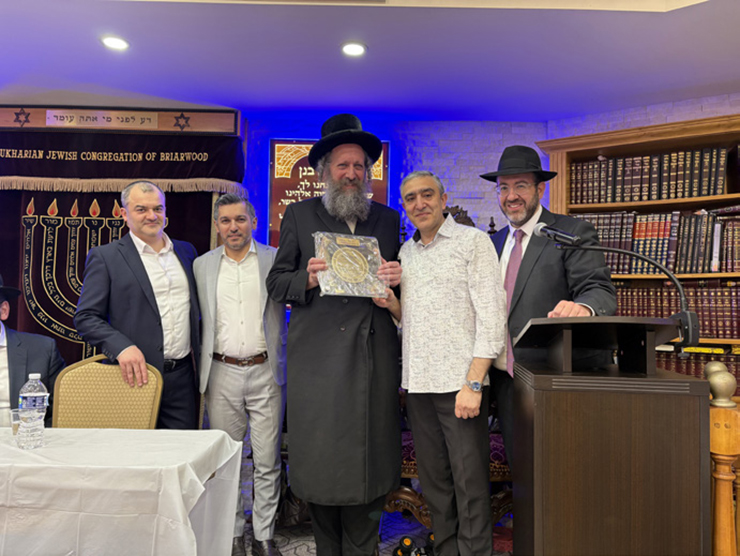
Rabbi Lamm taught that talmidei chachamim increase peace in the world. At the beginning of the year, Hashem determines how many wars there will be. When people argue in the beis midrash while learning together, that battle for truth deducts a war from the world.
He explained that a little bit of truth can deflect a great deal of falsehood. The world is busy with sheker, he said, but our business is emes. When we learn Gemara, we receive a taste of truth. Learning Gemara transforms a person into an ish emes.
Rabbi Avraham Gaon, Rosh Beis Midrash Etzion in the Bukharian Congregation of Briarwood, then addressed the crowd. He explained that the reason B’nei Yisrael complained in the previous week’s parshah was because they were afraid of who they would have to become.
He cited the teaching of the Ari that every vowel a person recites while learning Torah creates an angel to escort him to Olam HaBa.
“You need to say to yourself, ‘I want to become a gadol,’” Rabbi Gaon said.
Every Jew, he explained, has his own share in Olam HaBa. When that share is not claimed, it becomes hefker (ownerless). Quoting the words “If not now, when?” he urged everyone to make a commitment to regular Torah study.
Rabbi Naftali Rosenbaum, who does so much for the Bukharian Briarwood community and comes every day to teach, also spoke. He connected his remarks to the week’s parshah, which discusses tzitzis and how they remind us of the mitzvos of Hashem.
He cited the Baal HaTanya, who taught that a person must do mitzvos, and that this will help abolish all sins. Rabbi Rosenbaum added that when a person learns Torah regularly, he will see improvement in shalom bayis, parnasah, and his results in this world.
Following the siyum, the celebration continued with music and dancing.
May Hashem continue to bless this community with good health and a continued love of Torah and mitzvos. May that love influence all of us and help bring the g’ulah to klal Yisrael.