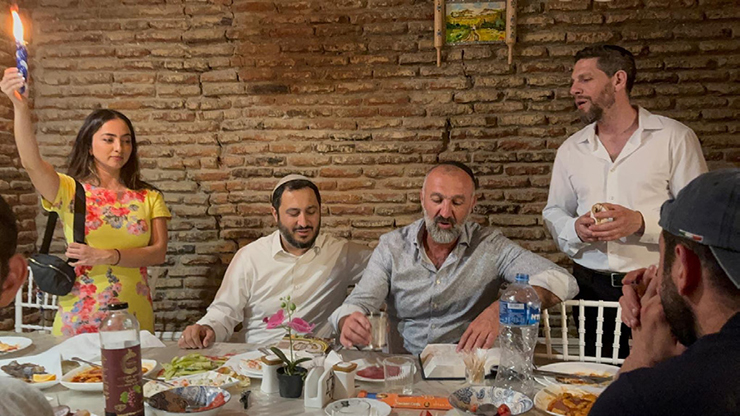
Straddling the Caucasus Mountains between Russia, Turkey, and Iran, the republic of Georgia is known to many Israeli travelers for its hospitality, resulting from its history and location. American Jews could look at the globe and regard this country as too distant. Last week, Manashe Khaimov of the nonprofit SAMI - Sephardic American Mizrachi Initiative, made the connection between American and Georgian Jews on a weeklong trip.
“This is the Jewish Silk Road,” he said. “The goal is to connect with the local community and see how their structure is done. Georgia has two kosher meat and two dairy restaurants. The whole concept is to support the local infrastructure.”
Previously, Khaimov led heritage tours in Uzbekistan, in which young Bukharian professionals visited the neighborhoods, synagogues, and cemeteries associated with their ancestors, met members of the community, and saw places associated with national history.
Khaimov reported that there are four kosher establishments in Georgia, and eating there was an opportunity to support the community. Elizabeth Yakobashvili learned about the trip from her sister-in-law, and as her husband, Albert, was born in Georgia, it was an opportunity to reconnect with his roots.
“We visited obscure villages,” the Staten Island resident said. “An elderly woman was asking us questions. She married a Georgian. She was one of the last two Jews in that village. She welcomed us into her home, cleaned the table for us, and told us her story.”
Khaimov added that her hometown, Oni, is the “Catskills of Georgia,” a mountain retreat for urban dwellers. He noted that her children made aliyah. “Her daughter married an Indian Jew, and her son married a Russian woman whose mother is Jewish. All of her grandkids are halachic Jews.”
In Akhaltsikhe, the group met Beniamin Levishvili, 24, the caretaker of the town’s synagogue. “It’s his responsibility to maintain the synagogue, as his father and grandfather were gabbaim,” Khaimov said.
The weeklong trip also spent considerable time in the capital, Tbilisi, which has a Jewish museum, and the seaside resort city of Batumi. “A lot of Israelis are in Tbilisi. You could hear Hebrew spoken all around us. Israelis feel very comfortable there; you don’t have to hide your Jewishness,” Khaimov said.
For centuries, Georgia was a tolerant home for Jews, whose centuries-old community did not have its own version of Yiddish or Ladino. They spoke Georgian and felt comfortable living among the majority population. Khaimov noted that unlike Jews in most Christian and Muslim nations, Georgian Jews did not live in designated ghettos. In recent years, it became a magnet for Israeli tourists as neighboring Turkey became hostile toward Israel.
“There were neighbors who knew my family, and it was very nice to see,” said Ari Shatock. “I felt a connection. It is a part of me.” The Brooklyn resident immigrated from Georgia at age three and, over the years, went on kosher trips to Italy, Poland, and Czechia, among other places, but with Georgia, it was unique and personal.
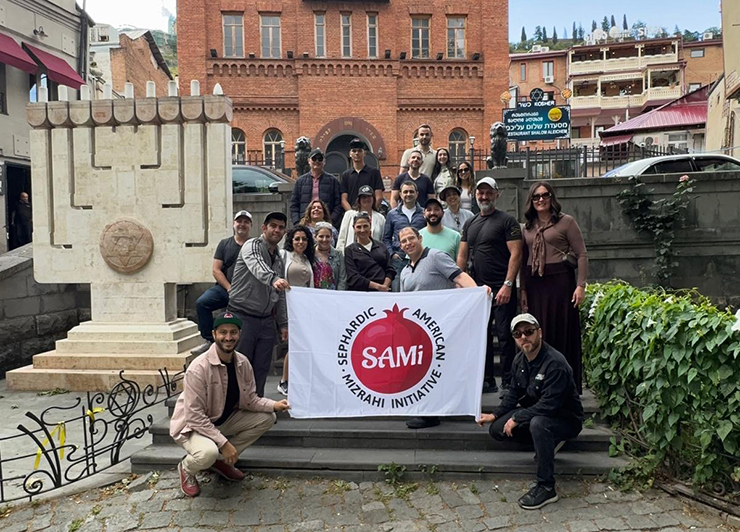
Elizabeth’s husband, Albert Yakobashvili, instantly felt at home speaking to the locals. “He was like a child in a candy store. He was reliving the stories of his parents and grandparents,” Khaimov said.
Having returned home, she noted that in Queens there is a small Georgian Jewish community that includes a shul on Yellowstone Boulevard, a kosher restaurant, and literature. At the Central Library in Jamaica, I was pleasantly surprised to find a bilingual book about 19th-century Georgian photographer Alexander Roinashvili, with images of Jews in his extensive portfolio.
The SAMI mission to Georgia had 22 participants, hailing from across the country, including Baltimore, Boston, Philadelphia, and Florida. “It was sold out,” Khaimov said. “We hope next year to add Azerbaijan and Tajikistan, places that a lot of people don’t go.” The trips are open to Jews of all backgrounds, with kosher food served and Shabbos services. To reach Georgia from New York, the shortest flight involves a stop either in Poland or Turkey.
“Manashe is very relatable. We had people of different spectrums of religion on the trip, and nobody felt excluded. He made sure the trip was on everyone’s level,” Yakobashvili said. As a Bukharian Jew, she expressed interest in traveling with SAMI to Uzbekistan and Tajikistan to connect with her family’s history.
Initially, the Yakobashvilis planned to visit Israel, but with the war against Iran and Hezbollah raging, they chose Georgia. On their way back to New York, they toured Italy and quickly saw the contrast between a society on the edge of Europe that welcomed Jews and a Western democracy where synagogues operate under tight security and Jews are discouraged from openly displaying their identity.
“I saw a Palestinian flag and graffiti,” Yakobashvili said. “In Georgia, you didn’t see these flags, graffiti, or demonstrations. You feel comfortable going to shul. Everyone wants to talk to you. The hospitality of the Georgian people reminds me of my husband’s grandparents.”
By Sergey Kadinsky