As America Marks 250 Years, a Historic Recognition of Shabbos Highlights Religious Liberty and Jewish Unity
This Friday night, across Queens, thousands of tiny flames will flicker to life almost simultaneously.
Along Main Street, the familiar pre-Shabbos rush will slowly settle. Bakery lines will thin out, last-minute kugels will slide into warming ovens, and children in polished shoes will hurry beside parents toward packed shuls. Phones will finally power down. In apartments and homes throughout Queens, tables prepared hours earlier will fill with z’miros, Torah, guests, and generations gathered together.
For the first time in American history, the White House is asking the country to notice.
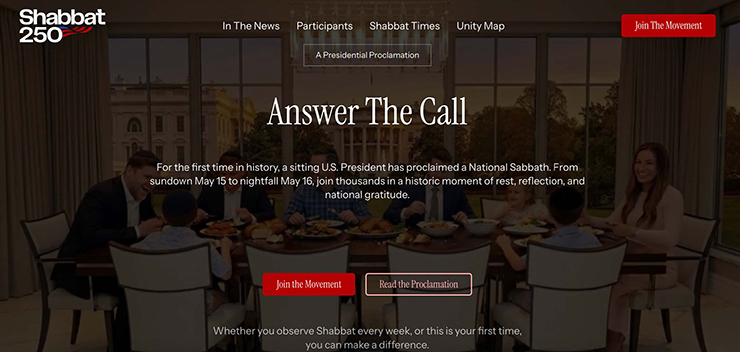
As the United States prepares to celebrate 250 years of independence, President Donald Trump’s administration has designated the weekend of May 15-16, 2026, as a national “Shabbat 250” observance – formally encouraging Americans to recognize a national Sabbath from sundown Friday through Saturday night.
A Recognition of Torah Life
For many in the Orthodox world, particularly in neighborhoods like ours, the announcement landed with genuine surprise. It isn’t that observant Jews need a government memo to keep Shabbos; we do not. Rather, it is the fact that the public recognition of Torah life is being placed at the very center of America’s 250th anniversary. It is a moment that earlier generations of American Jews could scarcely have imagined.
Whether one views President Trump as polarizing or transformational, few American presidents have tied faith so openly into American public life. The image of a sitting American president encouraging national recognition of Shabbos would have been unimaginable to earlier generations of Jews who struggled simply to keep their jobs while observing Friday night candle lighting.
For many immigrant Jewish families in the early 20th century, Shabbos observance was a quiet, costly battle. Workers routinely lost jobs for refusing to work on Friday nights or Saturdays, choosing faith over financial security week after week.
From the Iron Curtain to Main Street
For many Soviet Jewish families now living throughout Queens, the moment carries even deeper weight. There was a time when lighting Shabbos candles or teaching Torah behind the Iron Curtain carried enormous risk. Judaism was often practiced quietly under communist repression. Today, many of those same families sit openly around large Shabbos tables in Kew Gardens Hills, Rego Park, Forest Hills, and Fresh Meadows while the United States publicly honors the very observance they once struggled simply to preserve.
Time and time again, I hear community members speak about grandparents who hid Judaism in the Soviet Union or fled Eastern Europe as World War II erupted. Now, generations later, America is publicly honoring the very observance earlier Jews were once punished for keeping.
Rededicating the National Pause
The “Shabbat 250” initiative serves as part of the broader “Rededicate 250” campaign commemorating America’s semi-quincentennial celebration. The initiative reflects a wider effort to reconnect civic life with faith, gratitude, family, and national reflection. In choosing Shabbos, the administration turned to one of the oldest spiritual traditions in human history as a model for a national pause.
The proclamation invokes President George Washington’s famous 1790 letter to the Hebrew Congregation in Newport, Rhode Island, pledging that the United States would give “to bigotry no sanction, to persecution no assistance.” More than two centuries later, that promise still echoes through communities like ours.
At a time when American society feels overwhelmed by constant noise, screens, burnout, and political exhaustion, Shabbos suddenly feels less ancient and more urgently modern.
Unity in a Difficult Time
The proclamation also arrives during a deeply emotional period for American Jewry. Since the October 7 Hamas attacks on Israel and the surge in anti-Semitism that followed across campuses, social media, and major cities, many Jewish Americans have felt increasingly unsettled. Against that backdrop, the proclamation feels deeply personal.
One of the most striking aspects of the initiative is that America is not asking Jews to become less Jewish to participate in national life. Quite the opposite: The country is recognizing the Jewish contribution to America specifically through Shabbos itself.
The designated weekend coincides with Parshas BaMidbar, read just before Shavuos, commemorating the giving of the Torah at Har Sinai. Forty years ago, on Shabbos BaMidbar 5746 (1986), the Lubavitcher Rebbe, Rabbi Menachem M. Schneerson, called for a global Shabbos Achdus – a Shabbos of Jewish unity. The Rebbe taught that before receiving the Torah, the Jewish people stood at Sinai “as one man with one heart.”
Community and National Coordination
Support for the initiative quickly spread throughout the Orthodox Jewish world. Organizations including Agudath Israel of America, Aish, the Israel Heritage Foundation, and The Shabbos Project North America praised the proclamation and encouraged participation.
Much of the grassroots coordination behind the observance has been led by The Shabbos Project North America, under the direction of Robin Meyerson. Through Shabbat250.org, families across all 50 states can symbolically “add their light” to a national Unity Map and Scroll of Participants.
Rabbi A.D. Motzen of Agudath Israel described the initiative as an opportunity to reflect on the tremendous religious liberty Jews have enjoyed in America and the obligation of hakaras ha’tov (gratitude) for those blessings. Rabbi Steven Burg of Aish noted that the moment shifts the conversation toward celebrating what Jewish life positively contributes to America itself.
The Legacy of Kew Gardens Hills
In many ways, the story of Kew Gardens Hills is the story of Jewish America itself. The land once formed part of Spring Hill Farm, owned by Francis Lewis, a signer of the Declaration of Independence.
Then came the postwar explosion of Orthodox Jewish life. Institutions like the Young Israel of Kew Gardens Hills, under the legendary Rabbi Fabian Schonfeld, helped transform the neighborhood into one of the most important Torah communities in America. Kew Gardens Hills became a living example of what religious liberty could produce when Jews were finally allowed to build openly and proudly.
Perhaps nowhere is that history more visible than at Haym Salomon Square at Main Street and Vleigh Place. Haym Salomon, a Polish-Jewish immigrant and financial broker, played a critical role in financing the American Revolution. According to longstanding tradition, when George Washington asked Salomon what compensation he desired, he requested only one thing: lasting religious liberty for the Jewish people in America.
A History of Sacrifice
The freedoms celebrated during America’s 250th anniversary were not secured cheaply. Jewish Americans have defended this country since its very beginning:
Francis Salvador: the first Jewish soldier killed in the Revolutionary War
Judah Touro: who served in the Louisiana militia during the War of 1812
The Four Chaplains: including Rabbi Alexander Goode, who gave away his life jacket aboard the sinking USS Dorchester during World War II
Medal of Honor Recipients: including William Shemin, Benjamin Kaufman, Tibor “Ted” Rubin, and Captain Ben L. Salomon, a dentist who sacrificed his life defending wounded soldiers during the Battle of Saipan.
Generation after generation, Jewish Americans defended the freedoms that allowed Torah communities to flourish openly on American soil. Two hundred fifty years ago, America promised Jews freedom. Today, Jews are helping remind America how to pause. America gave Jews a sanctuary of freedom; Shabbos gives Jews a sanctuary of holiness.
For one historic weekend marking America’s 250th birthday, those two sanctuaries meet – not through slogans or political noise, but through glowing candles, crowded tables, families walking home from shul, and a country briefly remembering that freedom itself requires a soul.